













The US Navy (USN) has issued a preliminary set of contracts to develop an uncrewed fighter jet capable of operating from the service’s fleet of aircraft carriers.
While the US Air Force has been leading the charge to develop semi-autonomous tactical jets able to operate alongside conventional fighters, the navy is now launching its own programme.
Such platforms have been dubbed Collaborative Combat Aircraft (CCAs) by the air force, with the category more broadly known as autonomous collaborative platforms.
The news was first reported by Breaking Defense, albeit without confirmation from the Pentagon or any of the industry partners. The outlet reports that Boeing, General Atomics Aeronautical Systems, Northrop Grumman and Anduril Industries were all selected for initial development contracts.
US defence start-up Anduril on 5 September was the first manufacturer to confirm its participation in the navy programme.
“The US Navy has selected Anduril to develop designs for carrier-ready Collaborative Combat Aircraft,” Anduril says. “We are focused on delivering an aircraft built specifically to the navy’s distinct needs, at rapid speed and formidable scale.”
Anduril is a finalist for the air force CCA programme and is preparing to begin flight testing on its YFQ-44A prototype – a derivative of the company’s Fury uncrewed jet.
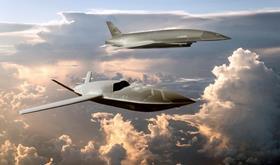
The company’s rival in that competition – General Atomics Aeronautical Systems – began test flights with its YFQ-42A prototype in late August.
C Mark Brinkley, head of strategic communications for General Atomics, declines to address the company’s status within the navy CCA programme.
However, Brinkley points out that General Atomics developed the electromagnetic catapult system featured on the USN’s latest generation of Ford-class aircraft carriers, the first example of which is currently deployed to Europe.
“We absolutely have carrier-capable CCAs in our sights, understand delivering at scale, and we’re excited about the opportunities ahead,” Brinkley said on 5 September. “It’s not a stretch for us.”
Boeing declines to comment, directing inquiries to the USN.
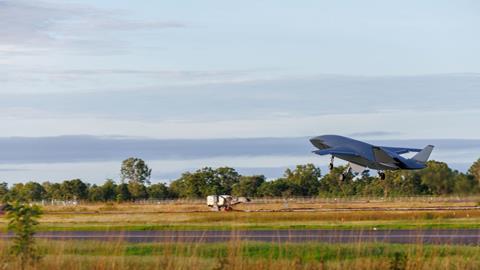
The airframer is conducting regular flights with its MQ-28 Ghost Bat design in Australia. That land-based autonomous jet was developed in partnership between Boeing and the Royal Australian Air Force.
Boeing is also preparing to begin flight testing on the MQ-25, an autonomous aerial refueller that the USN plans to operate in support of its carrier-based air wings.
The navy plans to begin carrier integration with the first production-model MQ-25 next year. An early MQ-25 prototype has already flown from land and conducted deck handling trials aboard a Nimitz-class carrier.
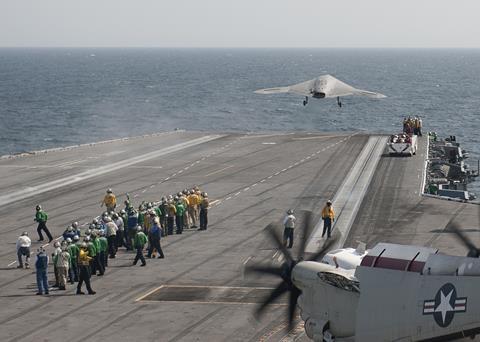
Northrop already has direct experience designing and building carrier based uncrewed aircraft. In 2013, it logged a successful catapult launch from the carrier USS George HW Bush with its experimental X-47B.
The company confirmed its involvement in the navy CCA programme to FlightGlobal on 5 September.
”We’re partnering with the US Navy to develop conceptual designs for their future collaborative combat aircraft and are bringing our deep experience in naval aviation and advanced autonomy,” Northrop says.
Earlier this year, Northrop launched the Beacon initiative to mature advanced aerospace technologies using a Scaled Composites Model 437 optionally autonomous jet.
The USN appears to be following the air force’s template for CCA development, issuing multiple early stage development contracts to competing designers, before narrowing down the field.
The air force hopes to select a winning design for its first FQ-designated uncrewed fighter by the fourth quarter of 2026, with the aircraft going into production soon after.
The service launched its initial CCA development contracts in early 2024, providing a possible guide to the navy’s timeline.