











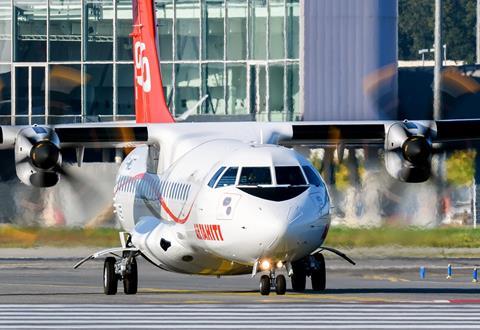
Investigators have determined that an Air Tahiti ATR 72-600 crew did not abort an approach to Atuona airport, despite its becoming destabilised, leading to dual control inputs and a hard landing.
The crew of the aircraft, arriving from Nuku Hiva airport in French Polynesia on 4 April 2022, had been given wind information by the Atuona tower.
But French investigation authority BEA says the “variability” of the measurements made them “difficult” for crews to use, particularly when choosing a runway.
Air Tahiti preferred that crews used runway 02, if tailwinds permitted; the opposite-direction runway 20 was subject to regular turbulence, particularly during descent.
But the pilots opted for an RNP approach to runway 20, having considered the tailwind conditions. This runway has a relatively steep 4° glidepath owing to terrain rising to 2,800ft east and west of the airport.
As the aircraft descended the pilots chose to increase approach speed, given the turbulent air. The first officer held the flightpath with “many large-amplitude inputs” to the throttle levers, says BEA, but the ATR experienced “significant” vertical-speed and airspeed deviations.
BEA says the crew perceived this as “usual”, adding that the recurrent turbulent conditions led to an “acceptance” of destabilisation, without rejection of the approach.
The first officer reduced the throttles to idle at 200ft above ground in a bid to “reabsorb” the excessive speed, it states. But below 100ft the headwind became a tailwind and the airspeed rapidly declined.
Analysis of flight data shows the descent rate rose from 750ft/min to around 1,250ft/min. “This situation may have been perceived by the crew as the aircraft being pushed down,” says BEA.
As the ATR overflew the runway threshold, the captain asked the first officer to increase power.
BEA says that, because the engines were operating at idle, more time was needed to counter the windshear than would have been required at a steady-state speed.
“When he perceived that the aircraft was sinking, the captain made a nose-up input on the control column, at the same time as the [first officer],” it adds.
“This reflex action, which was not called out, surprised the [first officer] who probably thought that his nose-up input had been inappropriate. This led him to make an opposite input.”
The forces during this dual input – the captain applying 650N nose-up and the first officer 300N nose-down – was sufficient to decouple the elevators.
Less than 1s later the main landing-gear touched down hard on the runway, and the aircraft bounced. Although the captain called for a go-around, and declared that he was taking control, the two pilots continued to make opposite dual inputs for 11s.
BEA says the crew subsequently assessed the situation and chose to carry out a visual approach to runway 02 instead. The ATR, which had 53 passengers and four crew members on board, landed safely.
Among safety measures implemented since the occurrence is a revision of Air Tahiti’s training programme to take into account stabilisation of steep-slope approaches, and aspects of opposite dual inputs.