













Contained within the plethora of newly-released information relating to last year’s fatal Washington mid-air collision are details of an uncannily similar incident, in the same location, during which the crew of an Embraer 170 narrowly avoided a military helicopter.
The National Transportation Safety Board’s docket on the 29 January 2025 collision includes a mandatory occurrence report filed on the incident 12 years earlier.
It was categorised as a “critical” event in the US FAA’s near mid-air collision database, and directly led to the formation of a working group for National airport tower personnel aimed at addressing concerns about helicopter operations in the area.
The Republic Airlines E170, inbound to Washington National in daylight on 24 May 2013, had been executing a circling approach to runway 33 – the same approach performed by the MHIRJ CRJ700 involved in last year’s collision.
Its crew originally followed a visual approach path north to National’s runway 1 but then agreed to the local controller’s offer of a circling approach to 33, after which the E170 was cleared to land.
At the time, a military Bell UH-1N helicopter – operating under the callsign ‘Muscle 9’ – was also flying north along the Potomac, following the designated Route 4, ahead of the E170 but travelling more slowly.
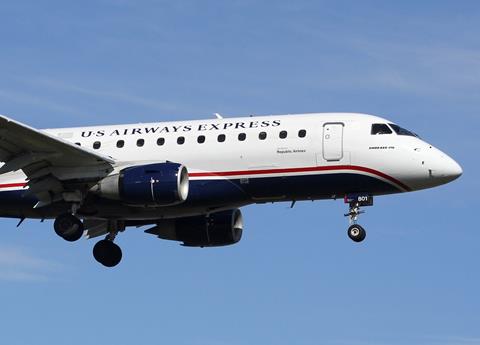
The controller informed the helicopter crew of the presence of the jet, which was descending through 3,200ft on final for runway 33.
“Muscle 9, we’ll be looking,” its crew replied, according to radio communications accompanying the radar playback data.
The E170 crew was also then advised of the helicopter 5nm ahead at 400ft.
Some 2min later the controller instructed the helicopter crew to make a 360° right-hand orbit and, referring to the inbound E170, “report him in sight”.
As the helicopter began the orbit, the controller again contacted its crew, to ask if they had the traffic in sight, to which the crew replied in the affirmative.
The helicopter crew was then told to maintain visual separation and “pass behind that traffic”, while the controller informed the E170 crew that the helicopter “off your right” would pass behind them.
“We got him in sight,” the E170 crew replied.
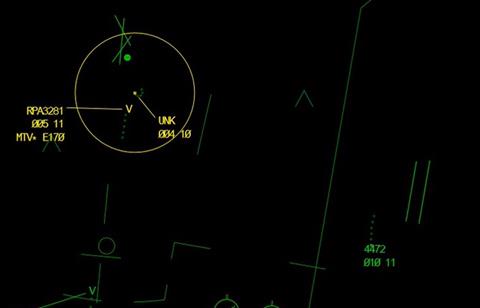
But the two aircraft continued to converge and, 15s later, the E170 crew stated that they were “going missed” – executing a go-around and commencing a right turn.
The mandatory occurrence report states that the aircraft were flying at the same height – radar information indicates both were at 400ft – and separated by just 0.18nm horizontally.
According to the radio communications, the controller initially told the E170 crew to turned right on a heading of 150°, before quickly correcting this to 050°, and to climb to 2,000ft.
The air traffic control service “did not issue adequate control instructions as necessary to ensure continued separation” between the E170 and the UH-1N, says the occurrence report, adding that separation was lost before the helicopter crew reported visual contact with the jet.
In a subsequent submission to NASA’s aviation safety reporting system, one of the E170 pilots stated that the helicopter made “what looked like a right turn directly into our flightpath”, and the captain made a “hard right turn” to avoid it.
When the National Transportation Safety Board convened on 27 January to discuss the circumstances of the CRJ700 collision with a Sikorsky UH-60L Black Hawk, air traffic control group chair Brian Soper pointed out that the “significant” 2013 incident took place “in the very same location” as last year’s accident.
He said the tower working group which arose from the incident, to address identified safety concerns with helicopter operations, proposed several recommendation to the FAA.
These included relocating or removing Route 4 – the helicopter path that the UH-1N had been following – in order to deconflict with National’s runway 33 approach corridor and runway 15 departure corridor.
But Soper said the FAA “chose not to act” on this recommendation, and Route 4 remained open – the same route travelled by the Black Hawk prior to the accident.
The inquiry into the collision says the FAA and the US Army failed to identify that the error tolerances of barometric altimeters contributed to helicopters “regularly” flying higher than the maximum published altitudes on such routes – and “potentially crossing into the runway 33 glidepath”.
Investigators found that the Black Hawk’s crew “did not receive salient information” regarding the CRJ’s following a circling approach to runway 33, owing to degraded radio reception. While the Black Hawk’s instructor pilot had requested visual separation, the inquiry adds, he had not positively identified the CRJ, despite claiming that he had the traffic in sight.