












Preliminary investigation into the AirACT Boeing 747-400 freighter excursion at Hong Kong have found that, after touchdown, forward thrust increased on the outboard right-hand engine – the thrust-reverser for which had been declared inoperative prior to departure.
Arriving from Dubai on 20 October, the crew had selected reverse thrust on the two inboard engines – each with 95% N1 power – after landing on runway 07L.
Reverse-thrust was also engaged for the left-hand outboard engine, but this was kept at idle power – perhaps because reverse was unavailable from the corresponding right-hand powerplant.
But as the aircraft conducted its landing roll, the autobrake disengaged, and the crew called for manual braking, says Hong Kong’s Air Accident Investigation Authority. The captain took control of the 747 from the first officer.
Flight-data recorder information shows that the outboard right-hand engine’s forward thrust then increased to 90% N1. This would have created an asymmetric thrust which would have tended to cause the 747 to yaw left.
While the inquiry is still trying to understand the reason for the engine’s acceleration, it says its thrust lever was found in the fully-forward position.
The selected thrust-reversers were all stowed about 5s after the forward power increase on the right-hand outboard engine.
This engine’s thrust continued to rise over the next 7s, reaching 107% of N1.
As the 747 veered off the left side of the runway, reverse-thrust was activated again for the three engines on which it was available.
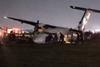
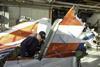
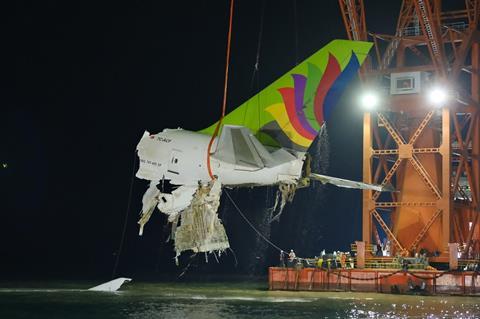
The aircraft collided with a security patrol vehicle and careered through the perimeter fence, breaking up as it came to rest in the sea.
Investigators have highlighted a number of findings from examination of the cockpit controls.
The thrust levers for both left-hand, and the inboard right-hand, engines were closed – with reverse-thrust levers for all three set to maximum – while the outboard right-hand engine’s thrust lever and reverse-thrust levers were in the fully-forward position.
Other observations included the autobrake selector indicating ‘disarmed’ and the speedbrake lever in the ‘flight detent’ position.
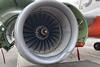
The aircraft, operating the flight for Emirates SkyCargo, was fitted with four GE Aerospace CF6 powerplants.
Investigators state that the “forward movement” of the outboard right-hand engine thrust lever is a particular focus for the inquiry, alongside the various other operational and maintenance aspects.
While the four crew members survived the accident, two occupants of the patrol vehicle did not.