














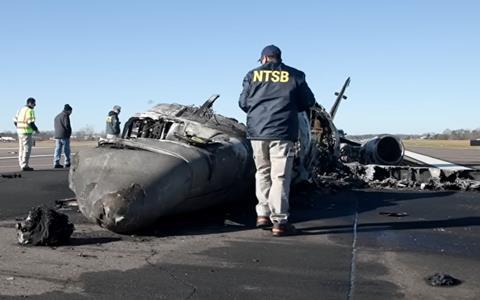
Investigators probing a fatal Cessna 550 Citation II accident in North Carolina last month have detailed evidence of instrument problems, and possible engine discrepancies, as it climbed away from Statesville regional airport.
The crash occurred on 18 December as the aircraft attempted to return to the airport with unspecified problems. It came down short of runway 28, with no survivors among the seven occupants.
Preliminary findings from the National Transportation Safety Board also reveal that the pilot’s type rating required a qualified first officer. But the passenger in the right-hand seat, the pilot’s adult son, was not qualified, only holding a private pilot’s licence for single-engined aircraft.
Bound for Sarasota, the jet departed from Statesville’s runway 10. The pilot performed the take-off while the right-seat passenger carried out checklists and radio communications.
A rear seat passenger – who held multi-engined aircraft ratings – was sat in the cabin, near the cockpit, and remarked during the take-off roll that the left engine was producing more power than the right.
GPS data shows the aircraft made a climbing left turn, turning 180° and reaching 2,200ft altitude before beginning to descend. The right-seat passenger attempted to activate the instrument flightplan by contacting Atlanta en route centre but was unsuccessful.
The pilot discussed a climb to higher altitude with the rear passenger while the jet continued to descend to about 1,580ft. As this climb was initiated, the rear passenger again noticed an apparent engine discrepancy, with an interstage turbine temperature difference between them.
“There were no further discussions regarding the engine instruments throughout the remainder of the [cockpit-voice] recording,” says the inquiry.
It says that the autopilot either disengaged automatically, or was de-activated, about 4min after take-off.
Shortly afterwards the cockpit-voice recording captured no intelligible audio from the left-seat microphone for nearly 4min. But the inquiry says the cockpit-area microphone picked up remarks from the pilot suggesting his “altitude indicator”, and other left-side instruments, were not functioning properly.
A multifunction display – a Garmin GTN-750 – stopped recording airspeed and heading data.
The pilot transferred control to the right-seat passenger as the aircraft reached 4,500ft.
No comments were captured on the cockpit-voice recorder indicating any malfunction with the right-side instruments. But the inquiry says severe degradation of audio quality on the recorder spread across all channels.
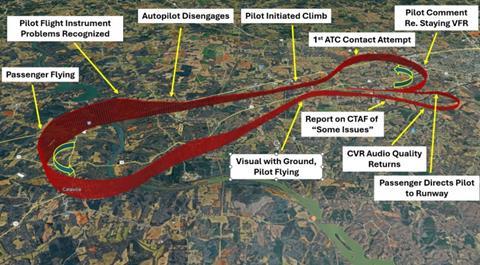
The aircraft’s flightpath indicates that it turned back towards the airport and began descending. The pilot, right-seat and rear passengers stated they could see the ground at about 1,870ft.
“Although a positive transfer of airplane control was not recorded, subsequent communication between the pilot and right-seat passenger was consistent with the pilot having resumed control of the airplane,” says the inquiry.
The pilot requested flap extension and landing-gear deployment; subsequent discussions were consistent with the landing gear being configured, although the landing-gear indicators lights were not illuminated.
Radio transmissions from the right-seat passenger referred to “having some issues here”, and a query from the rear passenger mentioned power to the “alternator” – although the aircraft was not fitted with such.
The inquiry says audio quality then returned to previous level on all the cockpit-voice recorder channels, in time to capture the pilot commenting about a “problem” without elaborating on its nature or any corrective action.
“There were no additional discussions regarding the pilot’s flight instrumentation for the remainder of the [cockpit-voice] recording,” it states.
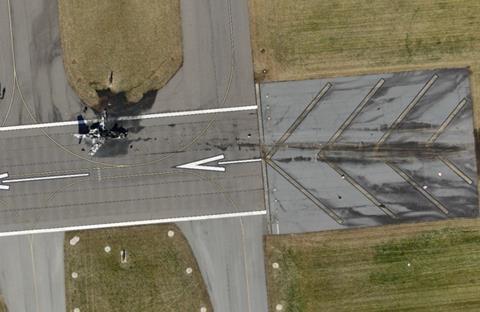
At an altitude of 1,325ft the aircraft started a left turn consistent with flying a base leg for runway 28. Airspeed recordings on the GTN-750 returned, and GPS data showed the jet rolled out of the turn onto the runway heading at 1,240ft, flying at 114kt.
The right-seat passenger visually acquired the runway, according to cockpit-voice information, and the GTN-750 data shows the aircraft’s altitude and airspeed continued to decline, to about 99kt, on final approach.
Statesville airport lies at an elevation of 965ft. But the aircraft descended to 942ft, colliding with an approach light stanchion 1,380ft from the runway threshold, before hitting additional lighting and then trees some 235ft from the initial impact point. The aircraft came to rest about 400ft short of the threshold and was consumed by fire.
Investigators have yet to confirm the nature and cause of the apparent technical problems encountered during the flight. The aircraft did not have a flight-data recorder, and was not required to be fitted with one.