












Italian investigators have determined that a LATAM Boeing 777-300ER crew introduced a 100t weight error while calculating take-off performance, resulting in a tail-strike at Milan Malpensa.
Investigation authority ANSV had previously indicated a discrepancy in the take-off parameters used by the crew and those calculated by the airline after the 9 July 2024 occurrence.
Bound for Sao Paulo, the twinjet (PT-MUG) suffered substantial damage during the tail-strike, as it lifted off from runway 35L, that the authority reclassified the event from a ‘serious incident’ to an ‘accident’.
Its cockpit crew comprised a captain undergoing training, in the left seat, a line-training captain in the right seat, plus a cruise captain.
The crew received the final loadsheet about 10min before pushback.
While the pilots entered the correct zero-fuel weight into the flight-management computer, the line-training captain made an error while mentally calculating the gross take-off weight.
He subtracted the expected fuel consumption during taxiing from the gross weight data presented on the flight computer’s display, but came up with 228.8t – some 100t lower than the correct figure of 328.4t.
ANSV says the line-training captain “announced the result of the subtraction aloud”, and this led both pilots to enter the wrong weight figure into their electronic flightbag during the take-off performance calculation.
With both pilots having used the voiced incorrect weight – rather than independently sourcing the data – the subsequent cross-check of the performance calculation naturally found matching speeds, configurations and engine settings.
ANSV says the check was only carried out only between the electronic flightbags, without comparing it with information from the final loadsheet or the flight-management computer.
The performance data was then entered, through dictation, into the flight-management computer.
Although all three pilots noticed that a message – ‘V-speeds unavailable’ – appeared on the computer display, and queried the reason, the inquiry says: “No-one could explain why the [speeds] were not appearing on the [display].”
Investigators point out that the configuration and assumed temperature data entered by the crew into the flight-management computer – derived from the incorrect take-off weight – meant the computer was “unable to calculate a valid take-off solution” within the available runway length.
This calculation conflict, in turn, generated the message that the speeds were unavailable.
If the performance calculations had used the correct weight, the pilots’ flightbags and the flight-management computer would have returned valid V-speeds – around 172kt and 181kt for V1 and rotation respectively, rather than the incorrect values of 145kt and 149kt.
ANSV says the crew “did not pay sufficient attention” to the V-speed message, and the fact that the speeds from the performance calculation were significantly lower than those typically obtained given the weight of the 777-300ER.
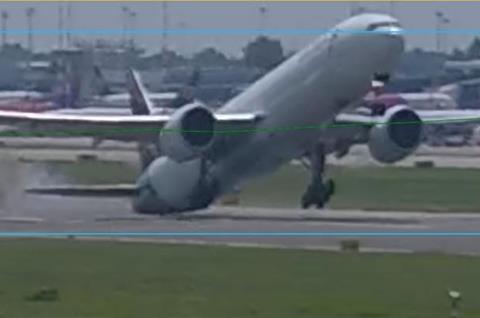
When the aircraft accelerated for take-off, it began rotating at 150kt – some 30kt below the speed required – and the wrong assumed temperature also meant the GE Aerospace GE90 engines were not delivering sufficient thrust.
Four seconds after initiation of rotation, the aircraft’s attitude reached 8.3° nose-up. At 160kt the tail-strike protection command was active and the tail contacted the runway.
“The aircraft had already greatly exceeded the decision speed, which was unreliable as it was calculated on an incorrect weight and with an inadequate engine thrust selection,” says the inquiry.
“Therefore, the option of aborting the take-off was not feasible. At the same time, the aircraft was not responding to the take-off input.”
With the front-seat pilots startled by the aircraft’s failure to respond, the cruise captain – who had a “greater margin of cognitive capacity” – intervened. Twelve seconds after rotation, he ordered the selection of full take-off thrust, and the line-training captain complied.
The aircraft lifted off at 178kt when it was 800m from the end of the runway, and the engines required a further 6s to reach maximum thrust of 106% of N1.
ANSV says positive climb was confirmed and, 21s after the rotation began, the 777-300ER overflew the threshold of the opposite-direction runway 18R at 155ft.
After the take-off checklist was completed, the line-training captain ordered a change of positions, taking over from captain-in-training and, in turn, being succeeded by the cruise captain. The crew made an urgency transmission and, after jettisoning 72t of fuel, returned to land on runway 35R.
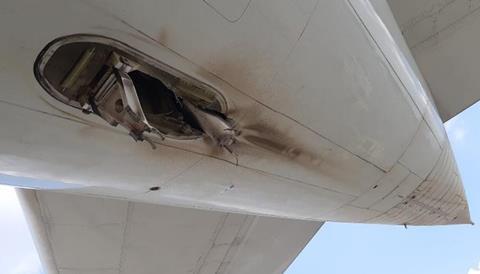
None of the 398 occupants was injured, although damage was found to the tail-skid assembly, drain mast, and auxiliary power unit fire-extinguishing system. During a subsequent detailed inspection, “numerous” other areas of damage were identified, says ANSV, leading to the reclassification of the occurrence. The aircraft resumed service about seven months later, in February last year.