










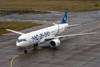

United Aircraft has flown the latest, fully import-substituted Yakovlev MC-21 prototype to the test centre at Moscow Zhukovsky from Irkutsk, to join the certification fleet.

The twinjet – which carried out its maiden flight towards the end of October – flew nonstop to Moscow, a sortie of 6h 15min.

Operated by a test crew of four, it flew at an altitude of around 11,000m (36,000ft), says the aerospace firm.

MC-21 73057-c-United Aircraft

Source: United Aircraft

Originally a -300 variant with Pratt & Whitney engines, the airframe has undergone extensive modification to a -310

The aircraft is the second import-substituted prototype of the MC-21, with foreign systems replaced by domestically-sourced equivalents. It was built as a -300 version, but converted to a -310 with Russian engines.

It will join another airframe, which had partial substitution, which was flown to Zhukovsky in mid-May.

“Specialists will prepare the aircraft, after which it will begin certification testing as part of the import substitution programme,” says United Aircraft.

According to test pilot Andrei Voropayev, who commanded the flight, the aircraft “performed flawlessly”.

Russian state technology firm Rostec says the programme to develop a fully-domesticated MC-21 has “entered its final stage” with the certification testing.

It says that a total of around 220-230 test flights are planned in order to “fully confirm” the twinjet’s compliance with safety and regulatory requirements.

While the primary testing will be conducted at Zhukovsky, certain procedures – such as anti-icing system checks – will be carried out at Arkhangelsk.

Chief designer Vitaly Naryshkin says virtually all systems have been replaced in the second prototype.

“The control system now uses exclusively domestically produced actuators, as well as cockpit controls,” says Rostec.

“Another important change is the Russian-made braking system, which has also proven itself to be highly effective.”

The prototype already has a Russian-source composite wing, which was fitted in 2021.

“Previously, the MC-21 was developed through extensive international co-operation, and many components had already been tested and proven on other aircraft models,” says Rostec.

Each imported system has been the subject of substitution efforts.

“This is challenging,” says Rostec. “The components must be comparable in weight and size, and withstand vibration, temperature fluctuations, and loads.”

It says the substitution programme has covered engines, electrical systems, controls, avionics, hydraulics, and air-conditioning systems.

United Aircraft chief Vadim Badekha says “hundreds” of aviation businesses, mostly within Rostec, are participating in the MC-21 programme.

“Serial production is already underway and, after receiving the type certificate, we are ready to deliver the aircraft to airlines. Our capacity fully meets market demand,” he says.