














A clutch of Canadian companies is in line for some C$62 million ($44.3 million) of research and technology funding dedicated to sustainable aerospace projects, including the integration of innovative anti-ice systems on Horizon Aircraft’s Cavorite X7.
Besides Horizon, lead recipients of the grants, made under the Initiative for Sustainable Aviation Technology (INSAT) programme, include Flying Whales, Certification Center Canada (3C), BioFlight Fuels and Thales.
Horizon-led Project CRYSTAL, which also involves 3C and the University of Toronto, is intended to develop an all-weather propulsion system for electric vertical take-off and landing (eVTOL) applications.
In its first phase, this will analyse the “viability of implementing advanced anti-icing, de-icing, and ice detection technologies” – including ice-phobic and electrothermal coating solutions developed by the University of Toronto – onto eVTOL aircraft.
A follow-on phase, supported by 3C, will “focus on testing and analysing the viability of the technologies on the Cavorite X7”, Horizon says.
Horizon will receive C$2 million in grants towards the total C$10.5 million project.
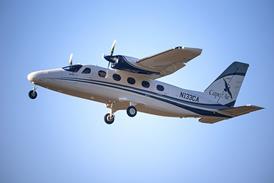
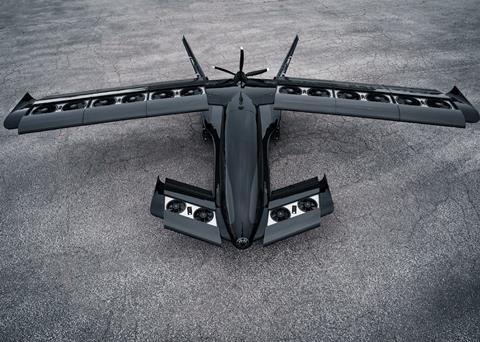
Capable of accommodating six passengers and one pilot on routes of up to 430nm (800km), the hybrid-electric Cavorite X7 uses an innovative system of electric-powered fans in the wings and canard to achieve vertical lift. Forward propulsion comes from a single pusher-configured propeller driven by a Pratt & Whitney Canada PT6 thermal engine.
Horizon is targeting certification and service entry for the Cavorite X7 by the end of the decade.
Also included in the latest round of INSAT initiatives – the programme’s third – are trials of sustainable aviation fuel, the development of ground testing infrastructure for new propulsion systems, and flight-control technology for the Flying Whales LCA60T cargo airship.
This will see the Canadian arms of French firms Flying Whales and Thales work together to develop the flight-control, avionics, and electrical-distribution systems for the LCA60T.
“These systems are essential for operations, particularly while hovering for the load exchange operations,” the project abstract states.
Ground testing and demonstrations on a simulator will raise the systems to technology readiness level (TRL) 7 by the end of the project. First flight of the LCA60T is scheduled for 2027.
Meanwhile, Thales Canada, eVTOL developer Jaunt Air Mobility Canada, and vertiport provider Vertiko Mobilite are to collaborate on new detect-and-avoid technologies for eVTOL aircraft and unmanned air vehicles.
The project will involve simulations, hardware prototyping, and flight tests to evaluate system performance.
INSAT is managed by not-for-profit organisation Strix, administering a total of C$350 million in Canadian government funding.