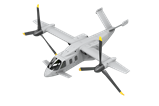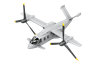















Horizon Aircraft has added two key suppliers for its Cavorite X7 prototype, signing up Rampf Composite Solutions and North Aircraft Industries to build the fuselage and wing, respectively, for the hybrid-electric vertical take-off and landing (VTOL) aircraft.
But while the firm is focused on the main VTOL configuration, the Canadian company continues to evaluate the potential of building a separate conventional take-off and landing (CTOL) prototype to expedite the development process.
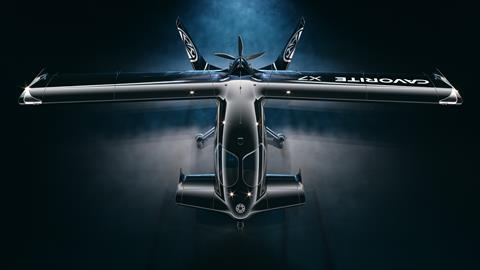
Selection of key parts of its supply chain – following the previous announcement of Pratt & Whitney Canada as propulsion partner – keeps Horizon on schedule towards the X7’s maiden sortie in 2027.
Assembly of the prototype should get under way later this year, with parts expected to arrive at the developer’s Lindsay, Ontario facility by the autumn, says chief executive Brandon Robinson.
Of the two structures, the wing is arguably the more complex as it features the Cavorite’s signature sliding wing covers that enclose 10 electric lift fans for VTOL operations.
“North Aircraft Industries has the experience, skill, and agility to keep our production of the Cavorite X7 on track,” says Robinson.
“We are proud to partner once again with a leading Canadian aerospace company that will play a critical role in completing the X7 and prepare it for testing in 2027.”
But Robinson, speaking at the recent Singapore air show, tells FlightGlobal that a decision on whether to also fabricate a CTOL test asset is “very close”.
“It makes a lot of sense to consider building two aircraft when you already have all the moulds – that way you can test vertical flight at the same time as testing horizontal flight,” he says.
Although this aircraft would not have the lift fans in place – instead featuring representative mass – it would nonetheless have the wiring looms installed to simplify their later installation.
Robinson says the supplier agreements also offer a potential route to low-rate initial production of the X7, providing a “short- to mid-term solution”.
“We have the advantage of not trying to produce thousands [of units] per year,” he says.
Horizon continues to assess a potential location for full-rate production, with multiple options in the greater Toronto area as the firm looks to tap into the region’s strong aerospace ecosystem.
Meanwhile, ground tests continue at system and subsystem level, as part of the preparation for first flight.
This includes evaluations of the PT6A thermal engine selected to propel the aircraft in forward flight and to generate the electricity needed to charge the Cavorite’s batteries.
While the PT6’s performance in its traditional propulsion role is a known quantity, Robinson says “we want to fully understand the hybridisation portion of it” as the firm assesses the exact hybrid architecture to employ.
Horizon recently disclosed minor changes to the Cavorite’s design, tweaking the lift-fan arrangement – it now features 12 rather than the 14 seen on previous iterations – and reshaping the canards and tail section.