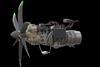














Blade-failure tests have been carried out on the Aviadvigatel PD-8 engine for Russia’s import-substituted Yakovlev SJ-100.
United Engine says the PD-8 passed the test “successfully” on a rig at its Saturn facility in Rybinsk.
This brings the engine for the twinjet closer to certification, it adds.
The test involves fitting a pyrotechnic charge on the root of a fan blade, and increasing the engine’s thrust to take-off power before detonating the charge and fracturing the blade.
United Engine says that, during the test, the blade fragments “did not penetrate the engine casing”. The PD-8 has 24 blades.
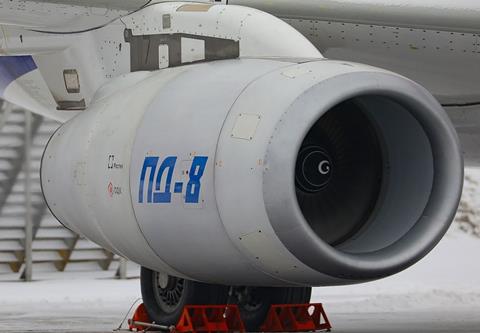
“Blade-breakage tests once again demonstrated the safe operation of the PD-8 in critical situations,” says Saturn deputy general designer for testing Alexei Veretennikov.
“Fragment retention was confirmed – one of the key points of the certification basis.”
This containment ensures fuselage integrity is maintained and enables the aircraft to land safely.
United Engine says the preparation work included installing air-sampling equipment to ensure that oil vapour emissions would not exceed limits within the air-conditioning system.
PD-8 testing has also covered acoustic monitoring, water ingestion, crosswind performance and thrust-reverser checks. All the key tests, says United Engine, were carried out at thrust levels of more than 78.4kN.
Russian aerospace firm United Aircraft intends the PD-8 to power not only the SJ-100 but also the Beriev Be-200 amphibious firefighter.
Saturn was a partner in the PowerJet joint venture with Safran which produced the SaM146 engine for the Superjet 100, the predecessor to the SJ-100. The PD-8 is a domestically-built engine intended to replace the SaM146 as part of efforts to reduce foreign supply to the SJ-100 programme.