












As the 50-year anniversary of British Airways’ and Air France’s launch of supersonic operations passes, the air transport sector remains relegated to the subsonic realm.
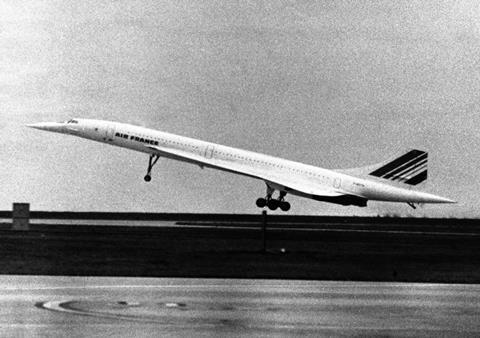
The two carriers simultaneously introduced BAC-Aerospatiale Concorde flights on 21 January 1976, operating the type for nearly 28 years.
Uncertainty over a revival of high-speed transport is highlighted in a recent European Union Aviation Safety Agency analysis of supersonic market developments – part of a broader preparatory study on higher-airspace operations, those above 55,000ft.
EASA estimates that, by 2035, annual total high-altitude traffic in European airspace could include 13,000 supersonic flights.
These flights would be part of a demand for higher-airspace access that is “significant, but low compared [with] traditional aviation”, it states.
The estimate is more optimistic than a previous paper of July 2022 from the SESAR Joint Undertaking – an air traffic modernisation partnership – which indicated supersonic flights would only connect major city pairs.
Based on a “conservative” 10% switch from subsonic to supersonic flights, the paper said, European airspace would see around eight round-trips – each with one arrival and one departure – daily in 2035.
The latest EASA scenario is highly dependent on substantial progress with supersonic aircraft proposals for the commercial or business sectors, and estimates of customer operations.
“Many supersonic civil commercial transport projects have been launched,” says the analysis. “Some have failed due to the lack of investors to face the significant environmental and economic challenges of civil supersonic flights.”
These casualties have included the Aerion AS2 business jet.
US-based Boom Supersonic’s Overture project “appears to be the most advanced”, says EASA, and has a chance to be in commercial service before 2035.
Overture “might be the only mature project” to deliver supersonic aircraft, it adds, but its production plans and intentions of candidate airlines – including American Airlines, United Airlines and Japan Airlines – offer an opportunity to estimate potential airspace demand.
The analysis suggests a medium-level scenario of 33 daily flights.
But the extremities of this forecast cover a wide range, illustrating the uncertainty surrounding supersonic evolution. The re-emergence of such flights requires addressing not only the environmental issues – the notorious sonic boom and high fuel demand – but also the economic equation, which will determine whether time-savings and service levels will convince passengers to pay premium fares.