












In 2019, Singapore was emerging as a new frontier in the electric air taxi sector. In October that year, advanced air mobility (AAM) start-up Volocopter gave a glimpse of the future with a 2min piloted flight over Marina Bay. It was a curtain-raiser for its plans to bring electric vertical take-off and landing (eVTOL) services to the city.
It was not to be. The German firm officially cancelled its Singapore scheme a year before the collapse of the entire business in December 2024 (although Volocopter’s assets have since been acquired by the Chinese owners of Austrian general aviation manufacturer Diamond).
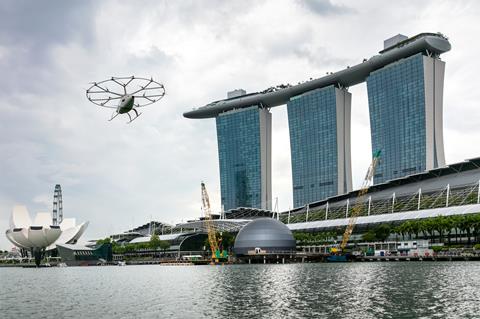
Unlike Dubai, where Volocopter also flew an early demonstration flight, Singapore appears to have cooled on the idea of becoming an AAM pioneer. That said, last year the country hosted a meeting of regional regulators which came up with a set of references for eventual eVTOL operations in Asia-Pacific.
Instead, the focus has shifted to other countries in Asia-Pacific, including Japan and South Korea, where western hemisphere developers including Archer, Eve, Joby, and Wisk have been striking deals with local governments and operators to co-operate on the possible launch of services.
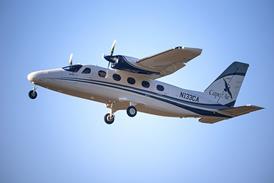
Meanwhile, Beta has chosen New Zealand for flight demonstrations of its electrically powered, Alia CS300 fixed-wing aircraft, carrying cargo over the Cook Strait that divides its two main islands.
In China, EHang remains the only eVTOL developer anywhere in the world to have gained civil certification, albeit only in its home market. Its autonomous EH216-S has been carrying passengers on sightseeing flights since 2024.
Elsewhere, the focus for developers has been on partnerships and securing deals. Eve, one of a handful of eVTOL companies exhibiting at the show, in March last year signed a memorandum of understanding (MoU) with South Korean helicopter operator UI to help create an AAM “ecosystem” in the country.
First Flight
Embraer-backed Eve, which in December completed the first flight of its uncrewed full-scale eVTOL prototype in Brazil, claims to have the biggest “pre-order” backlog in the region, with commitments for 450 aircraft.
Chief executive Johann Bordais says AAM “has the potential to reinvent global mobility, particularly in the dense urban areas that need it most”. Asia-Pacific’s expanding and congested “megacities”, a growing middle class, and a push for sustainable transport will drive demand for urban air mobility, he suggests.
In Japan, Archer is working with a Japan Airlines (JAL)-led consortium and the Tokyo metropolitan authority on the capital’s “eVTOL implementation project”, which will culminate in demonstration flights over Tokyo Bay and on river routes.
The Californian company, which is testing its Midnight eVTOL aircraft in the USA, also last year signed a deal with Korean Air to potentially purchase up to 100 Midnights, a move the airline said aimed “to lay the foundation of the next generation of air mobility” in the country.
Arch-rival Joby is also planting stakes in Japan, after conducting more than 40 flights of its eVTOL platform, in the livery of another Japanese airline, ANA, at September’s Osaka Expo. Working with ANA, it too plans to introduce an air taxi service in the Japanese capital.
Joby, which aims to launch passenger flights this year subject to regulatory approvals, is in a race with Archer to be the first Western conventional eVTOL company to start raising commercial revenues – although the United Arab Emirates, rather than an Asian country, is likely to be the location.
Boeing-owned Wisk has been lower profile than Archer or Joby – its eVTOL design is intended to fly autonomously rather than with pilots, adding a further regulatory challenge. However, it too has been active in the region.
In June last year, Wisk and JAL unveiled an MoU to explore the potential for AAM operations in the city of Kaga, designated a national strategic zone by the Japanese government for trialling new concepts.
Beta Approach
Beta Technologies has taken a different approach to its competitors, both in the design of its platform – the Alia CX300 is a fixed-wing, conventional take-off and landing (CTOL) aircraft, albeit electrically powered – and how it is introducing it to market. It is positioning the aircraft largely as a cargo platform.
In the final weeks of last year, Vermont-based Beta began a four-month series of flights in New Zealand including between capital Wellington at the bottom of the North Island of New Zealand and Blenheim at the northern tip of the South Island, in partnership with Air New Zealand (ANZ).
With 60% of flights in New Zealand less than 350km and a ready supply of renewable electricity, the flag carrier says the country is the “perfect laboratory” for next-generation aircraft.
“New Zealand is a country with a pioneering spirit and has always been a fantastic place to try new things,” says ANZ chief executive Nikhil Ravishankar. The trials will help come up with a plan to integrate electric aviation technology into New Zealand airspace “when it’s scalable and ready”, he adds.
Meanwhile, Canadian developer Horizon is making its Singapore air show debut, with chief executive Brandon Robinson saying Asia-Pacific offers a lot of opportunities for its hybrid-electric Cavorite X7 in “connecting islands and other difficult-to-reach places”.
The Cavorite X7 differs from many of its competitors in that it uses 12 electric fans for vertical lift, transitioning to a rear-mounted pusher propeller driven by a Pratt & Whitney Canada PT6A thermal engine for forward flight. The design means it can go further and faster than other eVTOL platforms, says the company.
Robinson says the Cavorite – after evaluating a scaled prototype, the Ontario-based company hopes to have a full-scale aircraft ready for testing by the end of this year – will be a much cheaper alternative to helicopters for many military, para-public and commercial missions.
“If you need long duration hover for mountain rescue or ship supply, this is probably not your machine,” he says. “But for shorter passenger or cargo journeys from A to B, it is pretty compelling.”
While most eVTOL developers committed to all-electric, “we didn’t pull any fast ones”, he argues. “We told people exactly what we were going to do, which was to have aviation gas on board. Our sell has always been creating network efficiencies.”
The UK’s Vertical Aerospace will also be exhibiting at Singapore. It comes weeks after customer Bristow unveiled plans to launch electric air taxi operations in the UK from 2029, using five of the company’s “certification ready” Valo aircraft, connecting London’s financial district with Cambridge and the capital’s two main airports.
Infrastructure Development
When it comes to AAM infrastructure, the leading player has been the UK’s Skyports, which has been working with Vertical, Eve, Joby and others on establishing networks of vertiports in their launch markets, including in South Korea and Japan.
In September last year, Skyports was appointed “lead vertiport developer” for the South Korea’s first commercial network, on Jeju island, a popular tourist destination. The provincial government there envisages eVTOL services launching by 2028, initially on a triangular route connecting the main airport with two resorts.
Skyports’ strategy has been to be a first mover, securing deals with cities and local governments once an operator or eVTOL developer has also committed. “We don’t expect to be the only player in this market, but being first is important in the real estate game,” says head of Asia Pacific and global operations Yun Yuan Tay.
He believes eVTOL missions in the region will range from urban air taxis, often connecting city centres to distant airports where ground public transport is lacking, to tourism flights, demand for which will grow as the middle-income population rises.
The Singapore eVTOL market, he maintains, will probably be largely cross-border services, offering an alternative to ferries for some of the tens of thousands of people who cross daily to the island nation from parts of Malaysia.
Other than EHang in China, the region has its own eVTOL developers, most notably Japan’s SkyDrive and Hyundai offshoot Supernal in South Korea. Honda has also expressed an interest in the market.
In October, SkyDrive completed a roughly six-week public demonstration campaign for its Model SD-05 prototype that began at Expo 2025 in Osaka and concluded at a new vertiport developed by the operator of the city’s subway network.
The immediate future of Supernal looks less certain after Hyundai last year paused the development of its planned SA-2 eVTOL in the USA and shed many of the unit’s management and technical team. The car maker, however, insists it remains committed to the AAM sector.
At the Singapore show two years ago, Supernal inked two memorandums of understanding with Singapore’s economic development board and civil aviation authority CAAS to “develop AAM capabilities and expertise in Singapore and the Asia-Pacific region”.
While Singapore may be less enthusiastic about launching its own eVTOL network, CAAS is playing a key role on the regulatory side, last July hosting 24 of its counterparts from the region, who adopted a set of reference materials that could lay the basis for a future regulatory environment for AAM as well as drones.
CAAS director-general Han Kok Juan said the region was set to be a “major market” for an AAM sector that would “transform the way people work, move, and live, and be another engine of economic growth”. The reference materials, he noted, were a “significant step to…making air taxi operations a reality”.