










Boeing has no immediate plans to activate its proposed 737 Max production line in Everett, Washington for at least another 12 months despite eyeing further output rises on the narrowbody.

The US airframer in January 2023 announced it would repurpose the space at Everett vacated by the end of the 747-8 programme, adding additional production capacity for the 737 beyond three existing lines at the single-aisle’s long-time home in Renton, around 40 miles to the south.

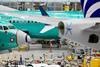
Boeing's 737 assembly facility in Renton, Washington 25 June 2024

Source: Jennifer Buchanan/Seattle Times

Boeing will end the year building 42 737 Max jets per month, with the next step 47 monthly

Sometimes referred to the as the “north” 737 Max line, the Everett line was supposed to come on stream in the second half of 2024.

However, these plans were put on hold after the US Federal Aviation Administration capped the firm’s narrowbody output at 38 monthly in early 2024 following a mid-cabin door-plug blow-out on an Alaska Airlines 737 Max 9.

Boeing recently gained FAA approval to raise the Max rate to 42 aircraft per month, a cadence it intends to achieve by year-end. Additional monthly increments of five aircraft are planned, spaced at least six months apart.

But Stephanie Pope, chief executive of Boeing Commercial Airplanes, says the airframer does not “need the north line for [rate] 47”.

“We have pretty much got the infrastructure set up for the north line… We have a very detailed, disciplined plan about how we are going to do that line – including how we are going to hire, how we are going to train, the logistics all around that – but we do not need that for 47.”

Instead, she says, “you should think of the fourth line as more of a rate-52 venue”.

Pope indicates that Everett will be used “more around making sure we have resiliency as we ramp up – so we’ll use it or not as we need it”.

Although Boeing earlier this year said the 737 Max 10 would be built exclusively at Everett, continued delays to the certification of that variant – service entry is now expected in 2026 – appear also to have weighed on its decision.

Nonetheless, Pope insists Boeing’s continued safety and quality improvements, “having reset how we build airplanes”, are paying dividends.

As well as wholesale internal changes, this has included extensive work with aerostructures supplier Spirit AeroSystems – a company in the final stages of being acquired by Boeing – to eradicate problems at source.

Boeing has set up a facility at Spirit’s Wichita plant – what it calls ‘position zero’ – to examine 737 fuselages for defects and to rectify these before they are shipped for final assembly. Previously, the airframer fixed those faults on site in Renton.

This has driven a “75% improvement in quality coming out of Spirit”, she told journalists at a pre-Dubai air show briefing on 16 November.

Additionally, “hundreds” of Boeing staff members worked ”hand in glove” with Spirit to aid the development and implementation of “its own safety and quality plan”.

“So just like Boeing builds airplanes differently using the safety management system and all the initiatives that we put into our factory, Spirit did a very, very similar plan and it is paying off significantly.”

Pope offers no timeline for the closure of the Spirit acquisition, pointing out that it is still awaiting the final regulatory approvals, but in the meantime, Boeing has drawn up a “very detailed integration plan” to bring the business back into the fold.

However, it will mean, at least on the commercial side of the operation, the end of the Spirit brand.

“They will become Boeing – and they are very excited, I can tell you, to become Boeing and we are very excited for them to become Boeing,” says Pope.

With the improvement process now bearing fruit, she maintains that Boeing is now “a different company” to the one prior to the Alaska incident.

“All companies have to learn from their past and I hope what you see emerging is a very humble company that is proud of its past but has learned from its mistakes.”