












European airline leaders are calling on the region’s regulators to take steps to support the competitiveness and growth of aviation, arguing the sector is at a “critical turning point”.
Airlines for Europe (A4E), the industry association which counts 16 leading airline and groups within its membership, in a chief executive’s declaration issued on 19 March said the recent airspace disruption in the Middle East served as a reminder of the resilience and importance of European Union airlines and hubs for connectivity with the rest of the world.
“We cannot continue to take for granted the progress that we have collectively achieved. EU airlines and passengers cannot keep absorbing ever-growing regulatory and cost burdens,” the CEOs say in the A4E statement.
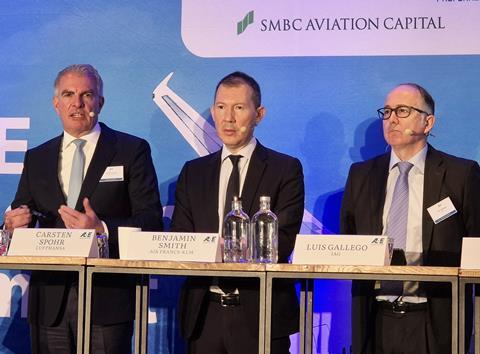
A4E says annual regulatory costs for its member airlines have tripled since 2014 to €15.5 billion ($17.8 billion) and are set to rise to €27.6 billion per year in 2030. ”European passengers and airlines cannot be left to shoulder the rising costs of sustainability, insufficient airspace capacity, delays and infrastructure investments alone – especially when Europe’s neighbours are not subject to the same costs and regulations,” the CEOs say.
It comes amid a significant a year for the European industry, with a string of legislations set for review and revision.
Notably, A4E leaders are calling for the Commission’s “long-overdue” update to its Aviation Strategy, which was drawn up in 2015 and is in the process of being reviewed, to adopt a “global and pro-growth aviation mindset”.
The association is also urging a reduction in EU Emissions Trading System (ETS) costs, arguing European passengers and airlines are being penalised for flying within Europe.
European regulators are expected in July to issue proposals for updating the ETS scheme, which for aviation currently only covers intra-European flights. Environmental campaign groups are pressing for the scheme to be extended to cover all flights in and out of the EU, rather than relying the global Carbon Offsetting and Reduction Scheme for International Aviation (CORSIA) developed through ICAO.
”ETS must not be extended to all departing flights from the EU,” the A4E CEOs say. ”Instead, the EU must work towards strengthening CORSIA to make it the only carbon pricing system globally.”
A4E leaders are also calling for immediate EU and government action to reduce the cost of sustainable aviation fuel (SAF), subject to progressively rising EU mandates on SAF uptake which took effect at the start of last year. ”The overall 6% SAF target of 2030 can be maintained, provided that SAF prices drop significantly,” A4E says.
However, leaders believe the eSAF requirement – a sub-mandate requiring 0.7% to be fuel uptake to be e-fuels by 2030 – is untenable given the lack of final investment decisions on eSAF production facilities. ”In these circumstances, the 2030 eSAF sub-mandate must be postponed until eSAF is sufficiently available and affordable, and the regulatory framework is redesigned to support diverse, affordable production pathways,” the association says.
A4E also made familiar calls around the burden of passenger rights compensation legislation and air traffic management disruption in Europe.
The existing EU261 passenger rights are also being reformed and airlines point to a balancing act needed between ”operational realities” and passenger rights in case of disruptions beyond airline control.
”What is being negotiated today behind closed doors is very far removed from the original Commission proposal,” A4E says. ”Higher EU261 costs risk harming connectivity and competitiveness more than even today’s poorly designed rules – particularly as non-European airlines are not subject to the same obligations.”
A4E leaders also reiterated their calls to limit the impact air traffic controller strikes in one member EU member can have across the whole region. ”EU leaders must take this concern more seriously: require mandatory arbitration before a strike is even called, set a 21-day advance notice for any industrial action, protect overflights while ensuring local departures and arrivals are not impacted, and guarantee a right of redress for airlines,” the CEOs argue.
The association also calls for a “targeted revision” of airport legislation, arguing airport charges could be reformed but suggesting the current slot rules do not need amending – arguing slot are being used well above 90% on average, and over 95% at major hubs.