












Saab has reported a record set of quarterly financial results for the last three months of 2025, with its performance having soared thanks to major deals secured by its aeronautics and surveillance business units.
Total orders placed in the three-month period valued SKr100 billion ($11 billion), the Swedish company announced during an annual results call on 5 February.
“This is the best quarter that Saab has ever generated,” says its chief executive, Micael Johansson. The achievement came as it also boosted its global workforce to almost 28,000 employees – up around 3,300 within a 12-month period – during what he describes as an ongoing “strong growth phase”.
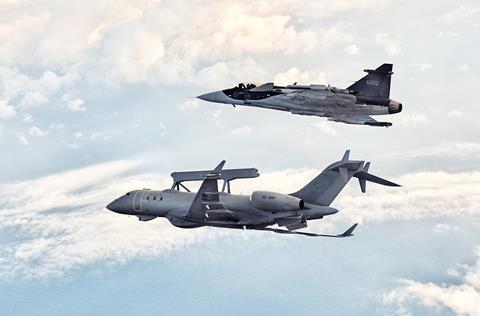
One major success was Colombia’s November signature of a contract to supply its air force with 17 Gripen fighters. Activities are scheduled to run through 2032 under the approximately €3.1 billion ($3.6 billion) deal, which will deliver 15 Gripen Es and a pair of two-seat F-model examples.
Saab had in August 2025 also secured an order for four Gripen Es from Thailand, as part of a planned 12-unit follow-on acquisition by the existing C/D-model operator. That purchase is worth SKr5.3 billion, spanning work to run through 2030.
Late-December also brought a major order from France’s DGA defence procurement agency, which signed for two GlobalEye airborne early warning and control (AEW&C) aircraft. That purchase is worth some SKr12.3 billion, Saab says, with deliveries due to occur between 2029 and 2032.
Paris also holds an option to potentially double its acquisition of the Bombardier Global 6500-based surveillance platform, which will replace its air force’s Boeing E-3F Airborne Warning and Control System fleet.
Buoyed by its strong performance last year, Saab is now pursuing multiple further sales opportunities with the Gripen E/F and GlobalEye. One notable prospect is Canada, which is being offered both systems.
CANADIAN PROSPECTS
“I would say that there two parts to Canada,” Johansson says. “One is campaigning to win a GlobalEye business encounter, and we are waiting for that procurement to happen.
“And then Canada is looking into ‘do we want to have sovereign capacity when it comes to aeronautics, not to be too dependent on the US’, by having a dual fleet, maybe both the [Lockheed Martin] F-35 and the Gripen.
“We are providing all the detailed information that they need to understand what it would mean to Canada. How quickly would we do a technology transfer? How quickly can we build up a Gripen hub in Canada for manufacturing? And how would they be involved in the full export market perspective of a fighter business?
“We are providing that, and they’re asking questions. But it’s a very high-level political decision that they have to make, and exactly when they will make that decision, I don’t know.”
Ottawa so far has ordered 16 F-35As from a planned 88-aircraft acquisition, but the procurement has been the subject of an ongoing review by the government of prime minister Mark Carney.
Saab also hopes to equip the government in Kyiv with its Gripen E/F, after Ukrainian President Volodymyr Zelensky late last year announced an interest in potentially acquiring 100-150 of the type during a visit to the airframer’s Linkoping production site.
“We would like to see Ukraine flying the Gripen going forward,” Johansson says. “We’re working that, and we hope that the financing side will be sorted and also for us then to prepare for industrial collaboration.”
Meanwhile, the company also is awaiting the outcome of an analysis being conducted by the NATO Support and Procurement Agency (NSPA) into the alliance’s future AEW&C capability.
“There is an assessment of the GlobalEye within NATO that will come to a decision in the first six months of this year,” he says.
“We have [replied to] requests for information from NSPA, because there are nine partner countries that want to have a common NATO capability. I think we have a great offer there with a great schedule, and there is a gap.”
The group of alliance members had previously indicated an intention to make an interim purchase of Boeing’s E-7A Wedgetail, but relaunched their assessment due to opposition to the 737NG-based type from the administration of US President Donald Trump.
Meanwhile, Johansson also points to wider interest in the GlobalEye, stating: “We have interest from a couple of countries in the Middle East.”
He declines to identify the nations involved, but with the United Arab Emirates already having a five-strong fleet of Global 6000-based examples in service, potential further prospects could potentially include Qatar and Saudi Arabia.
Saab reported sales of SKr79.1 billion for 2025, with its order backlog standing at SKr275 billion at year-end.