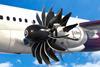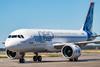
















Safran and its CFM International narrowbody engine joint venture with GE Aerospace remain in negotiations with Airbus over the ramp-up required on the Leap-1A to meet the airframer’s rate 75 A320neo production target in 2027 and beyond.
Airbus is planning to hit rate 75 – output of 75 A320neo-family jets per month – at some point in 2027, requiring its whole supply chain, but particularly engine makers CFM and Pratt & Whitney, to accelerate production accordingly.
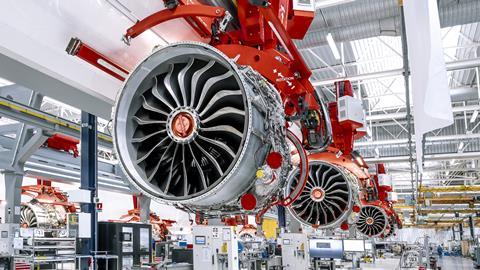
Safran chief executive Olivier Andries, briefing analysts on the firm’s nine-month revenue performance on 24 October, said although it had “an aligned view with Airbus” on the number of Leap-1A deliveries required in 2026 and 2027, an agreement on further increases has yet to be reached.
“We have engaged in discussions for rate 75,” he says. “The discussions are ongoing at the moment.”
But Andries hints that the high rate of production may only be reached late in 2027: “To my knowledge, Airbus has not said that rate 75 would be fully reached, full year, in 2027,” he says.
“We have a joint vision of the number of engines needed for 2026 and 2027 and we are discussing now 2028 and going forward.”
CFM delivered 1,240 Leap engines to its airframe customers Airbus, Boeing and Comac in the first nine months of the year, up 21% year on year, with 511 shipments in the third quarter alone – a strong recovery after a misfiring performance in the first half.
That saw a combination of supply chain disruption and industrial action at its Villaroche assembly plant near Paris, which caused Safran to fall behind the planned rate of Leap-1A deliveries to Airbus, forcing the airframer to stockpile what it terms “gliders” – completed aircraft absent their engines.
Andries says he is “confident” that it will catch up with the missed deliveries “by the end of October, beginning of November” if the current output is maintained.
Based on the improved performance, Safran and GE have raised their guidance for Leap deliveries this year to more than 20% above the 1,407-unit total achieved in 2024. Previously, they predicted an increase in the 15-20% range.
Leap-1As are an option on A320neo-family jets, while the -1B and -1C variants hold exclusive positions on the Boeing 737 Max and Comac C919, respectively.
To help meet future high Leap-1A production rates, Safran announced earlier this month that it will open a new assembly line for the powerplant in Casablanca, Morocco capable of building 350 engines per year.
Andries says the first engine will roll off the line in 2028 “and we will ramp up from there”, achieving 350 per year “by 2030 or so”.
While the investment in the new plant will enable Safran to “meet the high rates requested by our airframe customers”, Andries cautions that engine assembly is “only the tip of the iceberg”, with other parts of the supply chain needing to match those output levels.
Revenue in the propulsion division, which also includes military and helicopter engines, rose to €4 billion ($4.6 billion) in the third quarter, up 21% on the same period last year, and to €11.5 billion for the first nine months of 2025, up 18%.
For the aircraft equipment unit, revenues increased to €3 billion for the quarter and €8.6 billion for the nine-month period, boosted by the July acquisition of flight control and actuation activities from Collins Aerospace. Safran estimates the additions will contribute around €650 million to its revenues in 2025.
Andries says the former Collins employees are “enthusiastic to join Safran” and are “onboard” with its strategy: “They are very pleased to see we have a strategy going forward with respect to flight controls and the preparation for the next single-aisle.”
In the interiors segment, revenues hit €802 million in the third quarter and €2.4 billion across the nine-month period, driven by higher original equipment sales, notably of galleys and IFE equipment, as airframers ramped output.
However, this was slightly offset by lower deliveries of business-class seats, falling to 428 from 592 in the same quarter during 2024, due to ongoing industry-wide certification challenges.