












Rolls-Royce is promising a further time-on-wing boost for the Trent 1000 with the roll-out of a second phase of its durability enhancement package for the engine, an option on the Boeing 787, after obtaining certification for the latest high-pressure turbine (HPT) upgrades in late 2025.
While an initial package of enhancements is already being installed on new-build and in-service powerplants following regulatory approval in June, which more than doubles time-on-wing, the next phase should improve the figure by another 30%, says newly appointed Trent 1000 programme manager Rachel Walker.
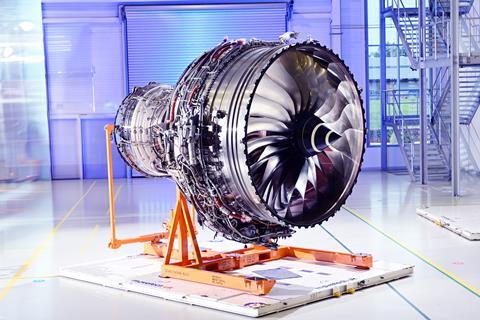
For the latest upgrade, Rolls-Royce has reduced the weight of the HPT blade shroud, cutting centrifugal stress on the component to extend its lifespan, and added new advanced coatings to the blades and nozzle guide vanes.
A first set of production blades is now virtually complete and “will be incorporated into the first OEM engines in the first quarter,” says Walker.
Roll-out of the phase-two upgrades into in-service engines will then take place from April onwards as powerplants come in for scheduled refurbishment.
Combined, the two durability-enhancement phases should offer up to triple the time-on-wing, Walker says and will bring “a huge amount of increased asset utilisation” alongside more predictable fleet management and “significantly improved fleet planning”.
So far, the engine maker has secured approvals from Boeing and the European and US regulators for the update, with others, including from the Japan Civil Aviation Bureau, expected in the coming months.
Installation of the first step is ongoing “at pace”, with upwards of 50 in-service Trent 1000s having received the improved HPT blades. Rolls-Royce aims to complete the roll-out across the remaining engines by the end of 2027.
To ensure it hits that goal, Rolls-Royce has added MRO capacity dedicated to the upgrade at sites in the UK, Germany and Singapore, enabling another 100 shop visits per annum.
Turn times are also being reduced through several other initiatives encompassing parts availability and technical documentation, Walker adds.
The first new-build Trent 1000 to incorporate the phase-one durability enhancement package – which Rolls-Royce brands the XE – entered service in November with Lufthansa.
Changes include new HPT blades, which feature 40% more cooling than their predecessors, plus updates to the combustion system, fuel spray nozzles and engine electronic controller software.
But it remains to be seen whether the benefits of the full DEP can completely repair the propulsion specialist’s troubled relationship with its Trent 1000 customers who have endured nearly a decade of issues with the engine.
Walker says the company is “grateful for the support that operators are giving us through this time” and is confident the improvements “will restore confidence in the product and fleet health”.
“Certainly, the feedback we’ve been having from customers so far is that they are very positive about the pace and intensity with which we are running the fleet [upgrade] and are very pleased with the engine so far,” she says.
Although conceding it is too early to comment on the long-term performance of the DEP, she says: “We know from our experience on the Trent 7000…we can see up to triple time-on-wing already from phase one”. The Trent 7000 is a sister engine which has already received the upgrades.
While the upgrades should lead to significantly better aircraft availability for existing operators, it is unclear whether this will translate into new orders.
El Al was the last operator to pick the Trent 1000 for its incoming 787s, an order placed in 2024. As of the end of that year – the most recent figures available – Rolls-Royce had 58 Trent 1000s still to deliver.
Meanwhile, the rival GE Aerospace GEnx has dominated the recent raft of Dreamliner sales, albeit in no small part aided by the linking of orders to wider trade agreements with the United States.
Walker insists there is a “huge market to go after” and that Rolls-Royce can be a “key contender” in future competitions.
“We believe these durability enhancements absolutely put us in a competitive position,” she says. “We are actively engaged with operators on any opportunity.”
Rolls-Royce is investing a total of £1 billion ($1.38 billion) to improve the durability of its entire portfolio of in-production Trent engines.