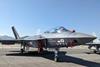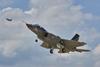















Korea Aerospace Industries (KAI) has revealed details of a conceptual advanced variant of its KF-21 fighter, designated KF-21EX.
A digital rendering shows several differences from the Block I aircraft now undergoing flight testing. The renderings suggest that a key goal of the concept is reducing the jet’s radar cross section (RCS).
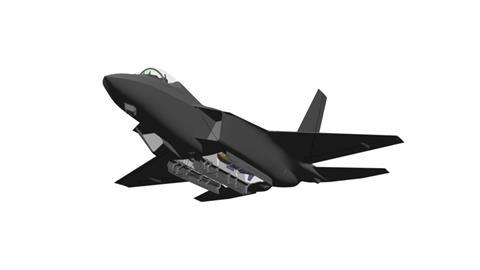
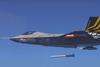
The KF-21EX features two internal weapons bays beneath the fuselage, which KAI says could carry beyond-visual-range air-to-air missiles, small diameter bombs and 907kg (2,000lb) guided bombs. By contrast, the current KF-21 uses this space for the external carriage of four MBDA Meteor long-range air-to-air missiles.
Other refinements include intake lips flush with the fuselage, replacing the small gap seen on the existing design, further reducing RCS.
In addition, the KF-21EX is depicted with an electro-optical targeting system (EOTS) under its chin. An EOTS capability is associated with stealth fighters such as the Lockheed Martin F-35, a type operated by South Korea, and China’s Chengdu J-20.
KAI says improvements are also envisaged in sensors, radar and electronic warfare performance, with the addition of a distributed aperture system to boost pilot situational awareness. Enhanced datalinks will support co-operation with unmanned aircraft, while overall combat radius will be increased.
“KAI is currently conceptualising the plan internally, but research and development are underway to secure core technologies,” says the company. It envisages the KF-21EX becoming a reality in the 2030s.
South Korea has ordered 40 KF-21s, with a commitment for more expected in the future. The type is set to enter service in late 2026. Seoul’s Defence Acquisition Program Promotion Committee recently decided to bring forward testing of the fighter’s air-to-ground weapons capabilities.