














The US military has activated its first-ever one-way attack squadron, operating a derivative of Iran’s prolific Shahed-136 kamikaze drone.
US Central Command (CENTCOM) revealed the creation of the new unit on 3 December, giving it the name Task Force Scorpion Strike. The task force’s priority is to quickly deliver low-cost and effective drone capabilities to frontline troops, according to the Pentagon.
“This new task force sets the conditions for using innovation as a deterrent,” says Admiral Brad Cooper, CENTCOM commander.
“Equipping our skilled war fighters faster with cutting-edge drone capabilities showcases US military innovation and strength, which deters bad actors,” he adds.
Notably, the first capability be delivered to the new Scorpion Strike task force is a low-cost uncrewed aircraft reverse engineered from Iran’s HESA Shahed-136.
An unspecified number of the new weapon, which has been dubbed the Low-cost Unmanned Combat Attack System (LUCAS), have already been deployed to the Middle East region.
The move marks a major shift for the Pentagon toward offensive applications for low-cost drones, which have up until now been viewed primarily as an air defence problem.
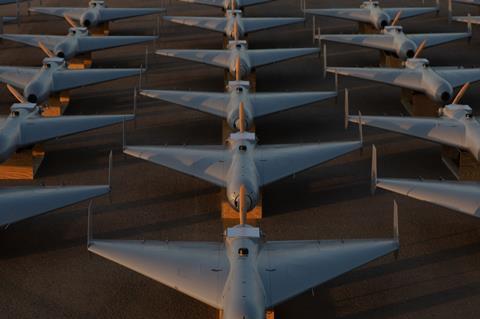
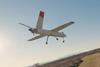
Photos released by CENTCOM show several rows of LUCAS drones staged at an undisclosed location.
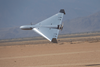
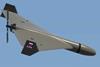
The LUCAS design features a number of similarities to the Shahed-136, including delta wing, rear-mounted propeller and vertical winglets.
CENTCOM does not offer much in the way of design specifications, but says the new munitions offer an “extensive range” and are designed to operate autonomously. The drones are ground-launched via catapult, rocket assist or mobile vehicle launcher.
It is not immediately clear who manufactured the new LUCAS drones.
However, the photos released by CENTCOM appear to match the FLM 136 produced by Arizona-based uncrewed aircraft manufacturer SpektreWorks.
The company describes the type as being “reverse-engineered for authentic threat emulation”.
In August, the US Air Force issued a request for information (RFI) seeking industry solutions for a Group 3 uncrewed aircraft with similar capabilities and characteristics to the Shahed-136.
The solicitation called for a one-to-one scale, reversed-engineered Shahed-136, with the same form, fit and function, including rear-facing propeller, the ability to carry 36kg (79lb) warheads, a fuel engine and a support crew of no more than three individuals.
Autonomous-capable flight was also listed as a requirement.
Each Shahed-136 has range of 1,350nm (2,500km), according to the Pentagon, with maximum airspeed of 100kt (185km/h). The craft are relatively small, with a 2.5m (8ft 2in) wingspan and weighing around 200kg.
Notably, the August RFI specified that the Shahed-derivative was intended for use as a target drone, rather than a frontline weapon system. It was meant to support the development and testing of new options for counter-UAS, which have emerged as a major weakness in air defence networks deployed by Western militaries.
It is unclear if the scope of counter-UAS target programme was expanded to include offensive capability, or if the Pentagon developed the LUCAS drones separately.
In July, US defence chief Pete Hegseth launched an initiative to dramatically expand the US military’s use of small drones, describing them as the “biggest battlefield innovation in a generation”.
CENTCOM directly cites Hegseth’s drone push as the impetus for the new Scorpion Strike task force and the forward fielding of the Shahed-based LUCAS vehicles.
Designed for production within Iran’s sanction-hobbled economy, Shaheds are simple and cheap, relying on commercially available components and boasting a total cost of around $50,000 per unit.
That is a fraction of the precision strike and anti-air missiles field by the US military, which cost anywhere from $238,000 to over $3 million per unit, according to analysis from the Center for Strategic and International Studies.
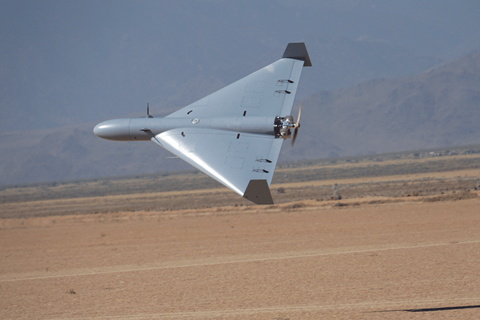
Tehran began supplying the one-way attack drones to Russia as early as 2022, as Moscow’s grinding war in Ukraine depleted Russian stocks of conventional munitions and expenditure rates challenged production capacity.
Russia now produces its own Shahed-136 derivative called the Geran-2 at high volumes, with the type seeing regular combat use in Ukraine – often against civilian population centres and critical infrastructure.
A newer model, dubbed the Geran-3 in Russia and the Shahed-238 in Iran, features a turbojet engine with significantly improved airspeed and range.
The small attack drones have posed a significant challenge for Ukrainian defenders, who often deploy expensive and resource-limited options like manned fighter jets or missile-based air defences to shoot them down.
The Pentagon has taken note of that asymmetry and begun pushing its industrial suppliers to deliver options for cheaper cruise missiles that could be produced, and expended, at much higher rates.
Defence manufacturers including L3Harris, Anduril Industries and Lockheed Martin are all developing options for such low-cost, high volume weapons.
Both the USA and Ukraine have also effectively adapted cheaper rocket systems like the BAE Systems APKWS II for counter-UAS duties, including air- and ground-launched options.
With the deployment of the LUCAS-armed attack squadron, the Pentagon now appears to be shifting from defence to offence when it comes to one-way drones.