













US investigators have revealed that a Delta Air Lines Airbus A330-900 underwent multiple rapid climb and descent cycles after it encountered turbulent conditions over Wyoming.
Its autopilot disengaged and the first officer of the aircraft – en route to Amsterdam from Salt Lake City on 30 July – initiated an upset-recovery strategy during the occurrence, which lasted around 2-3min.
Flight attendants had commenced cabin service as the aircraft climbed through 30,000ft and, upon reaching 35,000ft, the pilots observed only light cirrus cloud with no turbulence predicted on the electronic flightbag. The crew turned off the seatbelt sign.
As the climb continued to 37,000ft, the crew requested a deviation to the right to avoid some weather build-up but, after consideration, accepted a left turn to a heading of 350° instead.
“The crew assessed that heading would keep them above the cloud deck, upwind of weather build-ups, and they had not heard any adverse ride reports,” says the National Transportation Safety Board, adding that the only weather of concern on the aircraft’s radar was 40-50nm away.
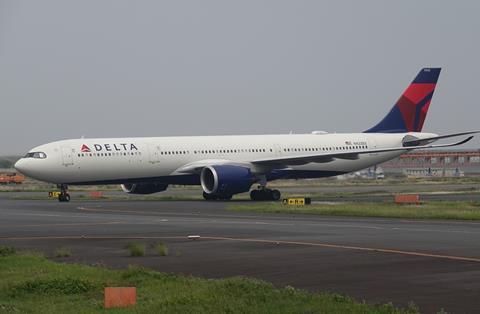
But as the A330 completed the turn, it experienced a 15-20kt overspeed and an updraught which pushed the jet up to 38,000ft in the space of 20s.
The autopilot disengaged and the aircraft descended “rapidly” to 35,500ft, says the safety board, and a climb-and-descent cycle repeated three times.
It states that the first officer, who was flying, initiated an all-attitude upset-recovery strategy – a four-step procedure designed to be easily recalled and to help offset startle effects.
This involves disconnecting the autopilot and autothrottle, before executing a ‘push-roll-power-stabilise’ sequence.
The pilot must push the sidestick forward to reduce angle-of-attack, roll to the horizon, and set thrust in accordance with the aircraft’s energy state, before stabilising the pitch and power.
This procedure was carried out “at least once” during the A330 upset, which lasted about 2min 30s, before the crew recovered and re-engaged the autopilot.
Preliminary flight-data recorder information showed the vertical acceleration oscillated, reaching a maximum positive peak of about 1.75g and a minimum negative peak of about -0.5g.
Pitch angle also fluctuated from 5° nose-down to 10° nose-up, while roll varied from 40° left to 5° right. Airspeed peaks ranged from 230-290kt.
The incident occurred near Creston, Wyoming, and the aircraft diverted to Minneapolis.
“After the event, the captain divided cockpit duties,” says the safety board, which is still probing the event.
“The [first officer] continued to fly and manage [air traffic control] communications, while the captain co-ordinated with the cabin crew and dispatch.”
It adds that a relief first officer, who had been in the crew rest, walked through the cabin to assess injuries, while a passenger – who was a physician assistant – helped cabin crew with triage.
Twenty-four of the 241 occupants were evaluated by medical emergency personnel, with 18 transported to local hospitals for assessment. Two of the 10 cabin crew members were seriously injured, with another five sustaining minor injuries.