
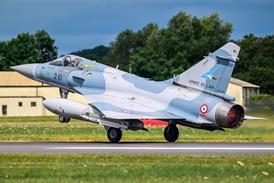












French investigators believe a vintage Fouga Magister fatally crashed into the sea during an air show after its pilot executed a tight turn to rejoin the display axis.
The accident occurred off the Mediterranean coast, near Toulon, on 16 August last year.
French investigation authority BEA says the V-tailed jet performed several passes, using an axis running northeast-southwest between the ports of Lavandou and Bormes-les-Mimosas.
These passes were interspersed with manoeuvres to reposition on the axis, which lay 750m from the public viewing area.
After about 3min of presentation, the pilot performed a 360° turn at about 60° bank – generating a force of around 2g – which began and ended beyond the axis.
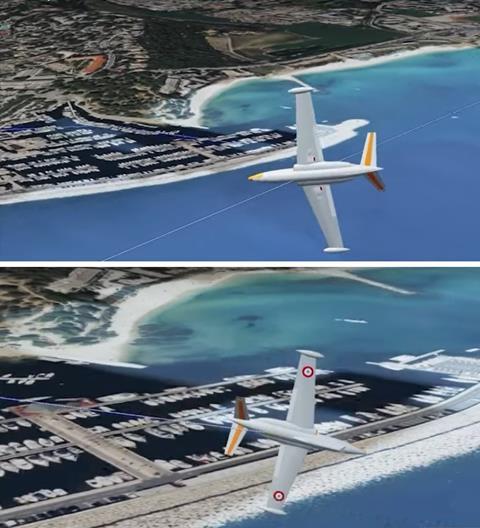
In order to return to the axis the pilot conducted a climbing right turn, and three-quarter roll. BEA says that, during this manoeuvre, he probably found himself facing, and close to, Bormes-les-Mimosas port.
This prompted him to tighten the turn to rejoin the axis, says the inquiry, causing the force to increase to 5g for about 10s – and probably peak at a higher level.
BEA says the pilot is likely to have suffered an altered level of consciousness, or even lost consciousness, as a result of the forces involved.
As the aircraft descended it stabilised, for a few seconds, at about 400ft before continuing to lose height and striking the water surface.
The Magister is not fitted with an ejection seat, and escape requires jettisoning the canopy and evacuating with a parachute.
Nor was the aircraft equipped with a system enabling the use of a g-suit, which would mitigate the effect of g-loading.
BEA says the pilot, who had little recent experience with performances over the sea, had mentioned “difficulties” in visualising the axis during rehearsal, and might not have taken sufficient account of wind conditions prior to conducting the final manoeuvre.