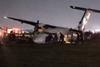













US investigators hope to obtain information shortly from the cockpit-voice and flight-data recorders retrieved from the regional jet which fatally collided with a firefighting vehicle at New York’s LaGuardia airport.
LaGuardia’s runway 4, the scene of the ground collision late on 22 March, is likely to remain closed for several days as specialists pick through an extensive debris field.
The Air Canada Express MHIRJ CRJ900’s cockpit disintegrated – fatally injuring the two pilots – as it struck a firefighting vehicle which was crossing the runway, the impact tipping the jet onto its tail.
National Transportation Safety Board chair Jennifer Homendy the New York Port Authority and emergency responders “cut a hole in the roof of the aircraft [and] dropped down” in order to recover the flight recorders, such was the jet’s resting position.
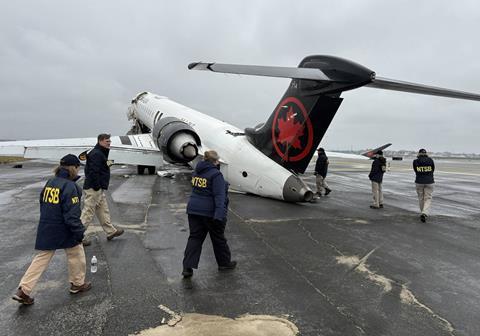
The recorders have been transferred to the safety board’s laboratory in Washington DC.
“We’ve been able to verify the [cockpit-voice] recorder was not damaged,” Homendy says, while examination of the flight-data recorder is still continuing.
Homendy says the recorders, along with data from the ASDE surface-movement radar provided by the US FAA, will help establish basic facts about the collision including the positions, speeds and distances of the aircraft and the firefighting vehicle.
The vehicle, carrying two firefighting personnel, had been crossing runway 4 at the taxiway D intersection when it was struck at 23:37.
NOTAM information from LaGuardia in the aftermath of the collision states that runway 4 is shut, along with multiple adjacent taxiways, as investigators inspects the scene – not only for evidence but for safety purposes.
Homendy says there is a “tremendous amount of debris” spread across the runway and taxiway D, as well as other areas.
“It’s pretty expansive,” she states, adding that there are also safety concerns regarding any hazardous material carried on the firefighting vehicle. Re-opening the runway is “going to take some time”, she says.
Homendy cautions that investigators are still collecting and checking data, and have yet to confirm much of the basic information which has emerged about the accident.
“We have a lot of data, a lot of information, including information on tower staffing,” she says.
“But the NTSB deals in facts. We don’t speculate. We don’t take one person at their word – we verify that information carefully before we provide it.”
The initial response, she adds, has been complicated by difficulties in gathering specialist team on site, owing to a groundstop at New York’s Newark airport as well as long lines at US airport security triggered by a partial government shutdown affecting the Department of Homeland Security.
Homendy says the inquiry’s air traffic control specialist was in line for 3h at security, forcing the safety board to call and “beg” for her to be allowed through to reach LaGuardia.
“It’s been a really big challenge to get the entire team here,” she adds.
While the safety board has yet to disclose specific details of the circumstances of the accident, FAA administrator Bryan Bedford states that the firefighting vehicle had been summoned to attend a United Airlines aircraft following its aborted take-off from LaGuardia’s runway 13.
“This is the reason why the fire and rescue crew had been deployed,” he says.
Bedford also indicates that adverse weather conditions – including mist and fog – were present at the time, reducing visibility to about 3.5nm.