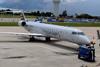













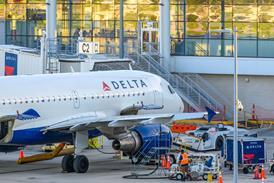
Preliminary investigations into the recent CommuteAir Embraer ERJ-145XR overrun at Roanoke have found the jet was high on the approach, but its captain proceeded to land despite two go-around calls from the first officer.
The aircraft was operating a United Express flight from Dulles to Roanoke-Blacksburg airport on 24 September, and the crew initially briefed for a localiser approach to runway 6, says the US National Transportation Safety Board.
After being informed by air traffic control that precipitation was present on the runway 6 approach, the captain – who was flying – opted to switch to the shorter runway 34 and conduct an ILS approach. The first officer set up this approach, and briefed the changes.
As the aircraft, arriving in darkness, turned onto final, the rain became heavy and the captain asked the first officer to carry out performance calculations for a wet-runway landing. The first officer determined that, without using reverse thrust, the aircraft would have a margin of 200ft.
The captain briefed go-around procedures and identified Greensboro’s Piedmont Triad airport as a diversion destination.
Rain intensity increased on short final and the captain requested a high setting for the windshield wipers.
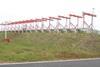
At 500ft the first officer saw the jet was high on the approach path, according to the runway’s precision-approach path indicator lights. Although the captain was correcting the flightpath, the first officer recalled the jet was “still high” as it crossed the threshold.
“After crossing the runway markings, the [first officer] called for a go-around, but the captain continued,” states the inquiry in preliminary information.
“About halfway down the runway, the [first officer] called for a go-around a second time, but the captain continued.”
Investigators have not stated precisely how far along the 5,810ft runway the ERJ touched down.
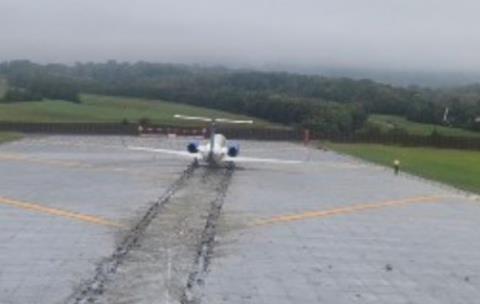
But the inquiry says the crew applied maximum braking and deployed the thrust-reversers. Despite these actions, the aircraft overran the runway end and was brought to a halt by the Engineered Materials Arresting System – a crushable surface designed to slow aircraft in the event of an excursion.
None of the 50 passengers and three crew members was injured, and the aircraft (N21129) sustained only minor damage. Circumstances of the incident are still under investigation and no formal conclusions have been drawn.