


















The aerospace engineer who claims to have come up with the term eVTOL – electric vertical take-off and landing – is behind a team designing Singapore’s first domestically developed electric air taxi, a scaled prototype of which is being formally unveiled today.
Professor James Wang, a former AgustaWestland research and development chief, and his 30-strong team from Nanyang Technological University have been working on the government-funded project for three years under heavy secrecy.
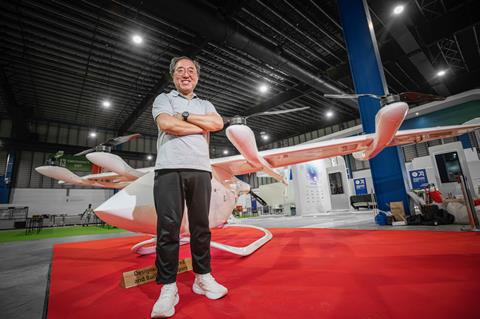
The model has an 8m (26ft) wingspan with eight wing-mounted rotors for vertical flight and a larger pusher-propeller for cruise, although a future production version will have a 14m wingspan, says Wang.
The aircraft, which made a series of short, tethered flights in September last year, will now transfer to German aerospace research body DLR for flight testing.
Wang and his group from the Singaporean research institution, are seeking further funding from the country’s authorities to make the next step to towards certification and production.
“Our goal is for an eVTOL aircraft that is designed, engineered, and built in Singapore,” he says.
Wang, who has also worked for Sikorsky, was behind the launch of the AgustaWestland (now Leonardo Helicopters) Project Zero – one of the first eVTOL concepts – in the early 2010s. The technology demonstrator was unveiled at the 2013 Paris air show.
It was around then that he coined the phrase that has become an industry term. Wang went on to advise many of the eVTOL start-ups before being lured to Singapore to lead the country’s own foray into the urban air mobility (UAM) world.
Wang is unfazed by the fact that the segment is crowded, with up to a dozen developers battling for funding – either from parent companies or market investors – and big names having collapsed or run out of money, insisting electric air taxis will flourish in the long run.
“It will take until 2035, but UAM will take off,” he says. “There will be room for lots of manufacturers.”
As for Singapore potentially entering the market late – most eVTOL developers began working on their projects in the previous decade – Wang believes barriers to entry will only become higher.
“This is the right time to get in,” he says. “This is something Singapore is determined to make happen.”