












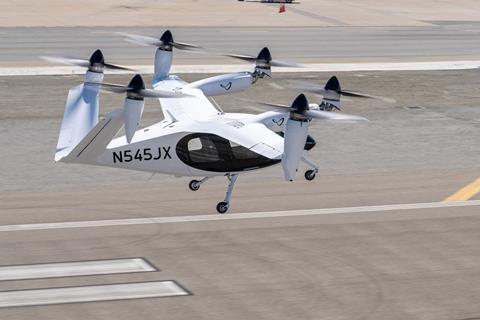
Joby Aviation recently received the first of two CAE flight simulators that are mission-critical for the electric air taxi developer’s pilot-training and certification efforts.
Since Joby’s four-passenger S4 aircraft has space for a single pilot, simulator time will be crucial for the development of Joby’s pilot pipeline – and is required by regulators in the USA and Middle East.
“You can’t actually instruct in the airplane… Sure, you could have somebody in a passenger seat talking to you. But then you’d have to be a licensed pilot to have a passenger, and they can’t instruct you,” says Bonny Simi, Joby’s president of operations.
“The instruction all has to happen in the simulator,” she says. “They will fly in the simulator first and then they’ll fly in the aircraft without passengers and without an instructor.”
Late last year, CAE presented the Level 7 simulator to Joby in Montreal. Then, the simulator was disassembled and shipped across the continent to Joby’s facilities in Marina, California.
The simulator will be now be assembled in a new 20,900sq m (225,000sq ft) facility in Marina that the company plans to use for expanded aircraft manufacturing.
“We specifically made a build-out in that building that is 40ft tall to be able to fit the simulator,” she says. “All the parts of the sim are in the building now, and CAE is on-site putting it all back together again.”
Level 7 is a designator given to “the highest-fidelity simulator possible” with a fixed base, Simi says. Joby expects its first pilot-training simulator will be operational by the end of next month or the beginning of March.
The second simulator – a Level C simulator – is a “carbon copy” of the first, except that it is mounted on mobile axis to provide pilots with a sense of motion during training. That unit is expected to arrive in Marina sometime in the second half of the year.
Simi says Joby’s Level 7 simulator is required to support the planned launch of operations in Dubai, whereas the Level C simulator with motion axis is required under the Federal Aviation Administration’s regulations for Part 135 operators, as well as the new SBAR (Standards Based Airworthiness) framework used by the FAA.
“A Level C sim is required per the regulations for an aircraft with single controls,” she says. “We started planning this back in 2019, before I joined Joby full time, I was on the board, and I was discussing the importance of a simulator for a whole lot of reasons – not least, it was going to be required.”
Joby signed an agreement with CAE in March 2022 to partner on pilot training, including developing and qualifying flight-training simulators.
“Used to simulate aircraft flight in various environments and conditions, flight simulators are an integral part of readying pilots to fly a new type of aircraft,” CAE said at the time.
Licensed commercial pilots will need about 25h in the CAE simulators before progressing to solo flights in the S4. “Pilots going into the Joby S4 will have to already be commercial instrument-rated pilots,” Simi says.
eVTOL PILOT PIPELINE
The two simulators will allow Joby to train about 250 pilots annually. It has not disclosed estimates of how many pilots will be needed to support the company’s vision of launching a new era of urban air mobility, though it has signalled plans to dramatically ramp up manufacturing to 500 aircraft annually.
Simi acknowledges Joby needs “a lot of pilots” to enable quick-turnaround operations with hundreds of electric vertical take-off and landing (eVTOL) aircraft – and that competition for qualified pilots is already intense.
“There is a global shortage [of pilots], and one of the challenges is the cost of pilot training,” she says. “If we can build a system where pilot training is much more accessible, then there will be less of a challenge. So this is what we’re doing, and we’ve started already with our pilot academy.”
Simi also points to the FAA’s MOSAIC (Modernization of Special Airworthiness Certification) programme. Finalised last year, MOSAIC updates the civil aviation regulator’s rules for light-sport aircraft certification and pilot qualification, with the aim of making flying more accessible.
”Light sport aircraft burn less fuel and are simpler to maintain,” Simi says. “You can build an academy around this, and we have built our Joby Academy using Vans aircraft – and we are actually building the aircraft ourselves with Vans. So we build our aircraft, the cost to operate those aircraft is significantly less… and the pilots are trained in the Joby way from the very beginning.”
Joby envisions making careers in aviation more accessible, to broader swaths of people. Piloting eVTOL aircraft – which will be primarily oriented toward short-haul flights in urban areas – could be an appealing proposition for people who prefer to work near home.
A former JetBlue Airways pilot, Simi has first-hand experience with the difficulties that come with raising a family while pursuing a commercial aviation career.
“The beautiful thing about our aircraft… is that it decidedly does not do all-nighters, and it does not do transcons,” she says. “So for people who want to live and work in the same community, it could be wonderful.”