















It is fair to say that business aviation, and commercial aviation broadly, is a conservative place when it comes to aircraft design.
Sure, new technologies and materials have been incorporated over the years, but with the honourable exception of the HondaJet, the standard template for a business jet remains a tube and wing configuration with a pair of engines mounted at the rear of the fuselage.
Although Bombardier has dabbled with its EcoJet blended-wing-body demonstrator, there seems little appetite to turn that into a development programme any time soon.
Of course, there are plenty who point to the vastly superior performance of the latest generation of business aircraft over predecessors, but such designs seem the result of evolution rather than revolution. Even fuel-burn improvements can be ascribed more to advances in engine technology than enhancements elsewhere.
That is not a criticism as such, simply a reflection that until very recently the technology – for both materials and manufacturing – was not sufficiently mature to permit any giant leap forward.
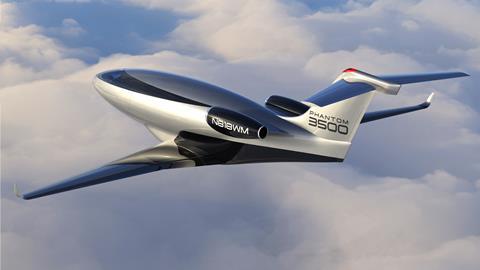
But now one US company thinks it can radically reshape the industry with a bold new design, using an ultra-low-drag formula to develop an aircraft advertised as punching above its weight.
Through harnessing the properties of laminar flow – the smooth flow of air over a surface, resulting in minimal drag – Fort Worth, Texas-based Otto Aerospace claims it can build a super-midsize business jet capable of carrying four passengers up to 3,200nm, or comfortably up to nine over a lower distance, but with significantly lower fuel burn than competing aircraft.
The business is the brainchild of Dr Bill Otto, who, having honed his knowledge of laminar flow while working to improve the design and performance of torpedoes, turned to aerospace in the belief that by applying the same drag-reduction principles to an aircraft, similar operational gains could be realised.
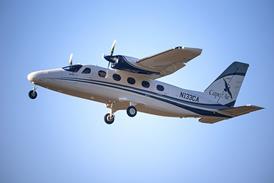
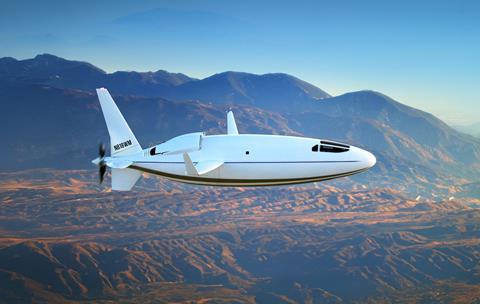
His work resulted in the Celera 500L, a demonstrator that flew from 2018 until early 2020. It was a curious-looking aircraft: featuring a rugby ball-shaped fuselage, long thin wings and a tail-mounted pusher-propeller, it was anything but conventional.
But crucially, it demonstrated that the underlying theory worked, explains company chief operating officer Scott Drennan. Flight tests stopped “because they had a really nice little set of data that proved that laminar flow was there, and ”, he says.
Back then, the company may have been “scrappy”, but it knew “how to build stuff and fly it on their own”, says Drennan, an aerospace engineering veteran with stints at companies including Bell under his belt.
Drennan joined Otto in late 2022, part of the team that came aboard alongside chief executive Paul Touw – founder of on-demand charter aircraft operator XOJet– following an investment by New Vista Capital, a business run by Touw’s wife and Dennis Muilenburg, former Boeing chief executive. (Notably, New Vista has also backed autonomous cargo drone maker Elroy Air and seaglider developer Regent.)
Coinciding with the arrival of and the rest of the new C-suite was a switch away from the Celera to a new aircraft design called the Phantom 3500. While perhaps not as radical as its forerunner, critically, the Phantom is more likely to achieve certification under existing US Federal Aviation Administration (FAA) rules, says Drennan.
“We are trying to do one miracle and that is laminar flow. That’s the technology which will create extremely efficient performance and extremely good economics – but those things aren’t part and parcel with the FAA’s concerns,” he says.
“The FAA is concerned with safety: if I don’t hit the performance through laminar flow or the economics through laminar flow we have a business problem not a certification problem.”
That ethos – ironically, a somewhat conservative approach – has also driven the selection of suppliers for the Phantom 3500 which read like a who’s-who of the business aviation world: Williams International’s proven FJ44-4 engines, a Honeywell Aerospace environmental control system, Garmin avionics and so on.
“It’s conventional in the sense that we want to reduce certification risk and get this minimum viable product into that sweet spot of the market and at the same time optimise around laminar flow, which creates the performance numbers that we need to attract customers in that segment,” says Drennan.
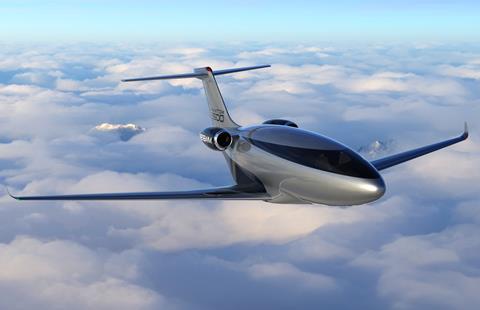
Still, with its sweeping lines, ultra-smooth surfaces and absence of passenger windows, the Phantom 3500 remains a striking aircraft. But despite the radical appearance, the big performance gains are not delivered where you might think.
“The wing is unique in its geometric configuration,” Drennan explains. “It is what really drives the laminar flow story for us.”
Drennan says the design achieves laminar flow over 90% of the wing during cruise, hitting slightly lower numbers during other flight phases.
“A lot of people think it’s the fuselage… Although that’s important for us, it is the wing that does the magic,” he adds.
Despite the company’s nickname for the structure being the entirely self-deprecating “big dumb wing”, this is the secret sauce for the programme.
Not only does the wing permit laminar flow, it also provides excellent short-field performance – balanced field length will be 914-1,070m, (3,000-3,500ft), says Drennan – alongside “great climb performance… to get us quickly up to 51,000ft”.
Otto claims the aircraft will be able to reach that altitude in on a 1,000nm (1,850km) mission. That cruising altitude is optimum for being – you guessed it – the best spot to generate laminar flow over the wing.
“And then when you are up there, instead of having a mushy airplane… because the wing’s not big enough, you have great handling qualities but the wing has now disappeared in drag,” he says.
The theory underpinning the Phantom 3500’s design is one of a virtuous circle. By Otto’s reckoning, the ultra-low-drag formula offers a 35% overall drag reduction, meaning the jet needs 35% less fuel payload and can use engines that are 42% smaller and therefore lighter than an aircraft with equivalent range. This, in turn, allows mass to be shaved from other components like the landing gear – a 52% cut overall – leading to an total 61% reduction in fuel burn and emissions.
Despite this, the Phantom 3500 will still be able to fly up to 3,200nm with four passengers, the company says. For comparison, the Pilatus PC-24 can transport four passengers up to 2,040nm, while the larger and heavier Bombardier Challenger 3500 can fly 3,400nm with the same number of passengers (albeit the Canadian jet can accommodate up to 10 people if needed).
In other words, while the Phantom 3500 will have a maximum take-off weight in the 8,610kg (19,000lb) range it will offer the performance of an 18,400kg aircraft. Indeed, that “big dumb wing” is actually not so big, relatively speaking, sitting between the PC-24’s 17m ( 55ft 9in)-span wing and the Challenger 3500’s 21m structure.
“We have a little more aspect ratio, which we love, and we have just enough [room] to fit all the fuel we need to do that coast-to-coast mission,” says Drennan. Comparatively, the Challenger 3500 carries around 6,400kg of fuel, he notes, against the Phantom 3500’s 3,400kg.
The “dumb” aspect, however, is driven by its lack of complexity: “It is a very simple wing – there are no leading-edge devices and just a simple drop-hinge trailing-edge device for a flaperon and aileron.”
Not only does this allow for simpler actuation and flight-control systems, it reduces weight.
Drennan is coy about wing-geometry specifics but says the shape of the leading edge encourages airflow to “stick” to the wing surface – meaning the air flows smoothly over wing, without disruption. Otto has applied for a patent for its wing design, as “the geometry is so specific”, he says.
There is a laminar-flow improvement from the fuselage too, with a 3.6m smooth run turning into an “adverse pressure gradient shape” to improve the transition between the laminar and turbulent flows at the rear of the aircraft.
The large, elliptical shape of the fuselage “makes for a living and customer-experience space that is just amazing”, with a 6ft 5in cabin height, he adds.
Mind you, the lack of passenger windows is certainly a difference that may take some getting used to.
There are multiple reasons behind this decision, says Drennan, including drag reduction, ease of manufacturing and increased safety through better fatigue life and structural integrity.
Otto’s replacement for the windows is a system it calls “Supernatural Vision” – ultra-high-definition screens along the cabin sidewalls showing real-time external views.
“It will create a customer experience that is second to none,” he says. “We already know, as we have started to talk to some customers, that they want that on board.
“We have a mock-up of the Supernatural Vision in the cabin and it’s like a cinematic worldview from any seat.”
Otto is focusing on the super-midsize segment with the Phantom 3500, seeing it as a “sweet spot” offering a total addressable market worth $25 billion.
But Drennan sees potential to offer a light- or medium-class alternative, too, simply by reducing the cabin size using dummy bulkheads or fewer seats, or lowering fuel capacity, to achieve a cheaper sticker price.
The critical question is whether theories around laminar flow translate into real-world performance. Drennan is convinced, pointing to data gleaned from flight tests of the Celera, which “landed bang-on that theoretical line”.
Two rounds of wind-tunnel testing of scaled models of the Phantom 3500 have reinforced Otto’s confidence, allowing it to now “optimise” the design.
A preliminary design review (PDR) is scheduled for November, effectively freezing the outer mould line, “and then we are off to the races on critical design, where we detail everything out and start building”.
The critical design review should take place about one year after the PDR.
Around 75-80% of the Phantom 3500’s supply chain is also in place, including Italy’s Leonardo for the composite fuselage, Belgian firm Sonaca for the wing and US company Re:Build Manufacturing for control surfaces. Parts yet to be contracted are largely build-to-print components, Drennan says.
New composite manufacturing techniques to achieve the smooth, gap-free surfaces essential for ensuring laminar flow are also being explored.
Using composites simplifies manufacturing and assembly, reducing part counts. For example, the fuselage is now two pieces – a top and a bottom section – as is the wing, while the vertical tail and horizontal stabilisers are together one piece, as is the cockpit.
Built into segments of the wing are the rib feet, spar and stringers, “so all of your fasteners just disappear to the inside of the structure”. The result? A smoother, low-drag surface.
“The best analogy for… how we build stuff is stealth aircraft. They have to control steps, gaps and waviness to avoid radar. We have to do the same to avoid drag,” says Drennan.
Otto plans for a first flight of the Phantom 3500 prototype in late 2027, with long-lead items and materials already on order. The engines for the test aircraft will be provided on loan from Williams. “That’s a great partnership model right there – that’s what we are looking for from our strategic partners.”
Four test aircraft are planned for the certification campaign, with the first being a “performance conforming” model and the remainder for FAA qualification. Assuming all goes well, that milestone is expected in late 2029 or early 2030, leading to service entry that year.
Thanks to an investment round earlier this year, Otto has sufficient funding to take the Phantom 3500 through the PDR. Another series raise is ongoing, which should conclude this year, and take the jet through first flight.
Earlier this year, Otto announced it would locate Phantom 3500 production at a new factory at Cecil airport in Jacksonville, Florida.
The company says, based on market forecasts, that by 2035 or 2036 and the start of steady-state production, it will be turning out 200-220 aircraft annually from the Jacksonville plant – roughly one every working day – which by 2040 should amount to 1,600 deliveries.
Drennan admits that target is “pretty sporty” but says, “We have appropriately designed our factory for it, and we have appropriately selected our supply chain partners who can easily achieve those kinds of rates.
“They have never had to do it in the business jet world, because there’s not been such a revolutionary product before, but they do it all the time with larger commercial aircraft.”

Otto’s production goals are “ambitious” rather than “greedy”, Drennan insists.
“It would only represent around 20% of the total market space, but we think we could do that or even better… I think we are going to be limited by our manufacturing capacity, not the demand,” he adds. “When we have talked to fleet operators they get very excited about this aircraft because you are talking hundreds of millions of dollars in savings for larger operators in fuel burn alone.”
That excitement may already be evident. In the weeks following FlightGlobal’s conversation with Drennan, Otto booked its first order for the Phantom 3500, securing fractional operator Flexjet as a launch customer.
Flexjet placed a firm order for up to 300 units, plus additional options – one of the largest orders from an OEM in business aviation history.
“For 30 years, Flexjet has led through innovation opposed to imitation, introducing tomorrow’s standards, not reacting to yesterday’s expectations,” says Flexjet chairman .
“The Phantom 3500 exemplifies that approach perfectly, marking a bold step into a future where an aircraft’s efficiency and sustainability stand alongside speed, comfort and range as defining standards,” he adds.