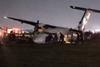
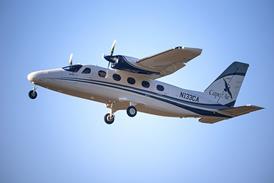













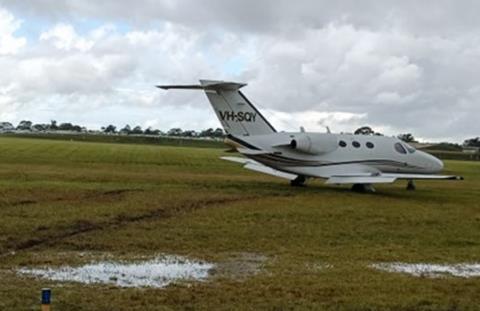
Australian investigators have determined that an undetected tailwind, and worn tyres, contributed to the overrun of a Cessna 510 conducting a medical air transport flight to Bankstown.
The AirMed Australia aircraft had departed Narrandera on 11 January with a pilot, nurse and patient on board.
As the jet descended through 550ft on approach to runway 11C, it was experiencing a headwind of 9kt.
But the Australian Transport Safety Bureau says the wind was variable, decreasing and switching to a tailwind at about 250ft. The tailwind increased to more than 6kt at 50ft.
The runway was wet and the tailwind meant the jet – which touched down at 93kt – landed with a groundspeed higher than the aquaplaning threshold.
Investigators found the aircraft’s main-gear tyres were “worn to limits” and this, combined with standing water on the runway, “reduced” the braking performance.
After sensing no deceleration, the pilot continued to hold brake pressure, and then opted to cycle the anti-skid system.
“While well intentioned, this [cycling] likely further decreased braking performance as brake pressure was released for portions of the landing, and the anti-skid system was momentarily not operational while a self-test was conducted,” says the inquiry.
It also points out that the aircraft’s flight manual requires maximum braking to be maintained throughout.
The aircraft’s groundspeed did not fall below the minimum aquaplaning speed of 72 kt until it was 900m into the landing roll.
With an overrun of the 1,259m (4,130ft) runway appearing inevitable, the pilot steered the jet slightly to the right to avoid lights, and the aircraft departed the runway end at 28kt. It continued for 30m on muddy ground before coming to a halt.
None of the three occupants was injured and the aircraft was undamaged.
Prior to departing Narrandera, the pilot had determined the runway at Bankstown would probably be wet, and – while headwinds were forecast – used a conservative 5kt tailwind to calculate landing distance, although landing with a tailwind on a wet runway was not recommended.
Investigators also learned that the pilot had been taught, during type-rating training provided by Air Link, to apply an incorrect 80% landing-distance factor. The inquiry found that a 60% factor was needed for the flight.
Despite the pilot’s using the wrong data, the inquiry – which calculated the actual landing distance required – says the pilot correctly concluded that a departure to Bankstown was possible.
AirMed has since updated landing-distance factors in its operations manual, and introduced reinforced requirements for landing calculations. It has also provided training to crews addressing tailwind effects, tyre limits and replacement, and correct use of the anti-skid function.
Investigators adds that Air Link subsequently amended training material for the Cessna 510 type rating to ensure that the correct landing distance factoring is applied and taught.