
















A US Air Force (USAF) weather reconnaissance flight was turned back after encountering severe turbulence while attempting to collect data on a powerful hurricane churning through the Caribbean Sea.
The incident occurred on 28 October involving a Lockheed Martin WC-130J aircraft being operated by the USAF’s 53rd Weather Reconnaissance Squadron (WRS) from the Dutch Caribbean territory of Curacao.
That unit, known colloquially as the “Hurricane Hunters”, specialise in providing aerial surveillance of tropical storms and hurricanes in the Atlantic Ocean, the Caribbean Sea, the Gulf of Mexico and the central Pacific Ocean for the USA’s National Hurricane Center in Miami.
The incident WC-130J flight, operated under the call sign TEAL 75, was collecting data on Hurricane Melissa, a severe Category 5 storm, ahead of the system’s landfall in Jamaica later that day.
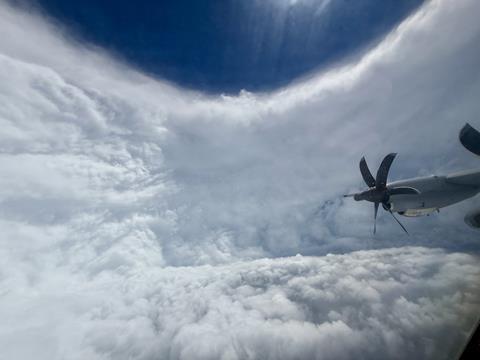
While passing through the eye wall of the swirling gale, TEAL 75 encountered heavy turbulence, forcing the crew to terminate the flight early and return to Curacao.
“During the event, the aircraft briefly experienced forces stronger than normal due to turbulence,” the 53rd WRS says. “While this does not automatically indicate damage, standard safety procedures require an inspection before returning to operations.”
Each hurricane flight includes an onboard navigator whose duties include monitoring radar for tornado activity, in an attempt to avoid the most severe effects of the storm.
However, the eye wall is the portion of a hurricane system where the strongest winds are found, rotating around the calm inner eye.
“Turbulence and electricity are just part of the job description,” the USAF’s 403rd Wing, the parent unit of the 53rd WRS, said in a 29 September post to X showing cockpit footage from a WC-130J flight passing through a heavy electrical storm.
A 53rd WRS flight call sign TEAL 74 successfully penetrated Melissa’s eye wall on 27 October, with the USAF sharing photos of towering, circular clouds topped by a sunny blue sky. 53rd WRS flight meteorologist Jeremy DeHart shared video of that sortie on X.
Clark separately described the TEAL 75 flight as a “mission for the ages”, sharing flight data that indicates the WC-130J lost, and regained, at least 700ft of altitude within the span of 1 minute.
Hurricane Melissa impacted Jamaica several hours later, causing extensive flooding and electrical outages. The system weakened before later impacting Cuba, Haiti and the Dominican Republic. At least seven deaths have been reported in connection with the hurricane.
The USAF operates 10 of the WC-130J-variant transports, with a total of 20 crews, making it one the most niche specialities within the service.
In addition to the navigator and pilots, each flight includes an onboard meteorologist and weather reconnaissance loadmaster.
The flight meteorologist acts as flight director, while also observing and recording weather data using an onboard computer. The loadmaster collects and records vertical weather information using parachute-borne sensors known as a dropsondes that gather weather data down to the ocean surface.
The 53rd WRS is the only unit of the USAF to perform hurricane flights. A separate team within the civil National Oceanic and Atmospheric Administration (NOAA) performs similar flights using Lockheed WP-3D aircraft – a specialised variant of the Cold War-era P-3 maritime patrol platform.
Although the USAF’s WC-130Js all range in age from 22- to 26-years old, they are substantially newer than NOAA’s aged pair of WP-3Ds, which have been in service for five decades, according to data from aviation analytics firm Cirium.
The civil climate agency has two new-build WC-130Js on order with Lockheed, according to Cirium, with delivery projected for 2030.
See video from the 53rd WRS TEAL 74 flight into the eye of Hurricane Melissa:
From a crewmember on yesterday's Teal 74 mission into now-Category 5 Hurricane #Melissa. As clear of an eye as you will see in the Atlantic basin. pic.twitter.com/5tktvvrIR1
— Jeremy DeHart (@JeremyDeHartWX) October 27, 2025