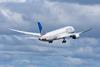















US investigators have attributed to windshear a damaging tail-strike involving a UPS Boeing 767-300F which occurred during landing at San Bernardino at the beginning of this year.
The aircraft, operating from Louisville on 9 January, had originally been bound for Ontario in California but diverted after a missed approach when the crew considered traffic, wind conditions and fuel reserves.
According to the crew testimony to the National Transportation Safety Board, the aircraft was stable on the ILS approach to San Bernardino’s runway 06, and the autopilot was disengaged at 500ft.
The captain, who was flying, said that, at about 100ft, he disconnected the autothrottle and “began a normal flare and round-out”.
“At approximately 15ft I felt the aircraft nose come up and sink-rate accelerate,” he added. “We contacted the runway slightly more firmly than usual, but the aircraft did not bounce.
“Once on the runway we received an aural ‘windshear’ warning.”
The first officer agreed that the aircraft “sank fast” at 15ft and the nose “simultaneously pitched up” before the jet touched down 1.5s later.
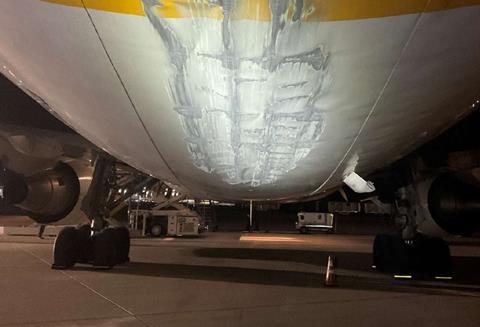
Flight data showed the aircraft’s pitch peaked at 8.1° nose-up at touchdown, enough for its aft lower fuselage to contact the runway surface.
The windshear warning, says the inquiry, was simultaneous with the touchdown and lasted about 5s. Flight data also showed horizontal stabiliser movement consistent with a tail-strike about 0.5s after touchdown.
Inspection of the aircraft – a 1998 airframe, registered N324UP – showed it had sustained substantial damage to the lower fuselage as a result of the strike. The tail-skid shock strut and horizontal stabiliser jackscrew were also damaged.
With no evidence that a mechanical failure of the jet caused the pitch-up, the inquiry has determined that the tail-strike resulted from a windshear encounter. None of the three occupants was injured.