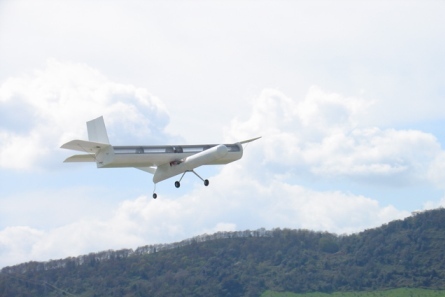
A FanWing Ltd Fanwing unmanned air vehicle has demonstrated that it can rotate at 1m (3ft). The Fanwing aircraft uses a bladed rotor turning on a horizontal axis, which acts as a thick wing.
Above: The short take off Fanwing flies during an April trial
This very short take off version is designed for urban operations where runway space would be very limited. The UAV, made from composite materials, has a 2kg (4.4lb) payload capability, combined wing/rotor span of 2.4m, a dry weight of 5.5kg, a 12kg maximum take off weight, a 1.2kW engine and a flight speed of 15.5kt (28.8km/h).
Its development goal is an 80min autonomous flight capability.
The England-based FanWing was set up in 1999 to develop blade wing technologies.
Singapore-based ST Engineering has disclosed details of its DrN-600 vertical take-off unmanned aircraft, a medium-lift platform designed for commercial cargo delivery and military logistics operations with a 100kg payload capacity.
California-based start-up Grid Aero has begun ground testing its Lifter Lite uncrewed cargo aircraft, less than a year after publicly unveiling the twin-engined turboprop design intended as a companion to the Lockheed Martin C-130 transport.
UK cargo drone developer Windracers is gearing up to build more than 100 examples of its Ultra Mk2 aircraft this year as it ramps up production to meet soaring demand.