













Hydrogen powertrain developer ZeroAvia has finally broken its silence on the sweeping redundancies made by the company in recent weeks that have seen around half of its workforce culled on the back of funding constraints.
But the sharp reduction in staffing levels has also seen the firm adapt its development plans. It is now pushing for certification in 2027 only for the fuel cell system rather than the complete powertrain as previously hoped.
Money, or rather a lack of it, is behind the swingeing cuts. Although ZeroAvia closed a financing round in December, extending its cash runway for another two years, a challenging funding environment meant it was not a “substantially upscaled round” over its $150 million, 2024 Series C raise, says chief executive Val Miftakhov.
“Overall, I would say about half of the staff has been let go. This is a reflection of the amount of funding that we are able to pull in and what was available for us given the environment,” he says.
“We started pulling these levers as soon as it became clear that the amounts [raised] would not be compatible for running two years with the same size workforce.”
As late as the third quarter of last year, the company employed around 300 people, he says, “and it was clear that, with the momentum of the fundraise, we would not be able to support that for 24 months.”
Miftakhov says the headcount reduction has been spread almost equally between its sites: Everett in Washington state, in the US, and Sandwich and Kemble in the UK. While it is hard to obtain a precise figure, the most recent accounts for the UK operation, covering the 12 months to end-2024, show an average of 220 staff.
While those at the coal face have borne the brunt of the redundancies, there have been departures from the executive team as well: chief financial officer Georgy Egorov will leave the business at the end of March, while Paul Murphy, chief technical officer for electric propulsion, was laid off last year.
But with the reduced workforce and limited funds, ZeroAvia has also had to adjust its development roadmap, or “compress its ambition”, as Miftakhov puts it.
Under its most recent timeline the company hoped to have both the electric propulsion system (EPS) – the electric motor and associated equipment such as inverters – and the full ZA600 fuel cell powertrain certificated by 2027, a date already several years behind its original schedule.
Now, however, ZeroAvia will prioritise development of the fuel cell system module – sometimes referred to as the power generation system (PGS) – aiming to achieve certification for this “first meaningful commercial product” in 2027.
Consequently, arrival of the ZA600 powertrain will slip by 12-24 months, although that timeframe depends on the amount of future funding it can secure.
But Miftakhov thinks mastering the fuel cell system will be a crucial “enabling part” of the wider powertrain: “Once we have that, then restarting, or reaccelerating the electric propulsion is what we will need to do.
“The degree and speed of that reacceleration will depend on how much money we pull in next time.”
Miftakhov remains hopeful that ZeroAvia can achieve a supplemental type certificate for integration of the ZA600 on the Cessna Caravan – the powertrain’s first application – in a similar timeframe, with much work taking place in parallel. As little as six months of additional effort following certification may be required to achieve the STC, he says.
Additionally, the timeframe for the larger 2MW-class ZA2000 system – suitable for conversion of larger turboprop aircraft – has been “pushed out” by a similar factor of “one or two years”, delaying it into the early 2030s.
Besides the straitened finances and smaller team, Miftakhov says the strategic change was prompted by the potential for sales of the PGS to bring in revenues in the nearer term.
“We have seen a lot of demand over the last 12 months especially for this fuel cell module from various types of customers, including civil and defence,” he says.
Besides primary propulsion, potential applications include a range extender for battery-powered aircraft or to provide auxiliary power for onboard equipment, particularly in the defence market.
Despite the job losses, Miftakhov remains confident that ZeroAvia has enough remaining capability to achieve the new certification target.
“I would say we do have the requisite resource, not only on the executive team, but in the broader management and engineering teams, to deliver on our objectives for the next 24 months.”

Work on the EPS will continue in Everett, albeit at “a much slower pace”, with the site also serving as base from which to address potential US defence customers.
To date, ZeroAvia has produced several of the 647kW motors, Miftakhov says, which have been run successfully in ground testing.
“We were able to confirm the operation although we did have a number of learnings from that test process – most around manufacturability, and when things go wrong, how easy it is to repair, fix and put it all back together.”
“Significant progress” has also been made in agreeing a certification pathway for the EPS with the US Federal Aviation Administration.
Miftakhov says ZeroAvia will stick with its vertical integration strategy, pointing to the lack of alternative electric motors in the required power class.
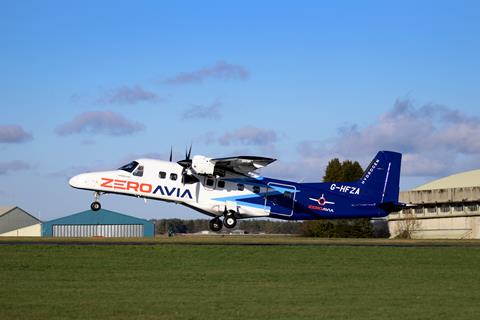
However, another consequence of the revised development roadmap is that no flight-test activity is foreseen for “the next 12 to perhaps 18 months”, resulting in redundancies in the flight-test team.
Although some maintenance activities will still need to be performed on its two Dornier 228 test aircraft to keep them airworthy, “we are not going to fly for the next 12 months for sure.”
An initial round of ZA600 test flights using a Do 228 ended in April 2024 after 12 sorties.
Miftakhov is also staying tight-lipped on exactly how much was brought in during the last financial raise, which he describes as an extension of the Series C round, rather than the “significantly higher amount” envisaged for Series D.
Despite the “first close” in December, the funding round will continue until 31 March with investors showing “significant interest on top of that first amount”.
A subsequent round should kick off in early 2027, giving the company sufficient time to demonstrate “some significant technical milestones on the fuel cell certification pathway”.
Meanwhile, ZeroAvia remains committed to relocating fuel cell system production to a new site it will build near Glasgow airport in Scotland.
Indeed, Miftakhov says the updated strategy will benefit the new site, sending more work there sooner, with the site effectively becoming its first production facility. Full-rate output is expected in the 2028 timeframe, building on initial activity in 2027.
However, its “overall trajectory” will spell the end for ZeroAvia’s presence in Sandwich in southeast England – acquired with the 2022 purchase of fuel cell developer HyPoint – as the firm consolidates its R&D work in Kemble.
Miftakhov admits to his sadness at the layoffs - “it’s not a great time to be contracting instead of building out”, he says – but takes heart from ZeroAvia’s resilience.
“We are fortunate to be among the survivors. Not everyone in the deep-tech space, especially in sustainability, especially in the heavily regulated, high-capital intensity space like aviation, has survived through this last 18 to 24 months of tight capital availability.
“So, we are fortunate to be among the ones to continue.”