















Southwest Airlines has completed cabin modifications across its 300-strong fleet of Boeing 737-700s ahead of launching assigned seating and extra-legroom seats on 27 January.
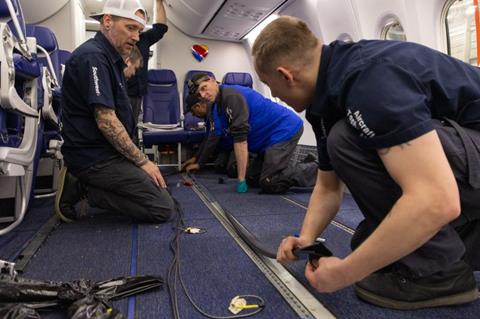
Chief financial officer Tom Doxey confirmed in a 21 January LinkedIn post that the airline has wrapped up the modification work on its 737-700s, which involved removing a row of seats from each jet.
”Our original plan had this work beginning prior to the 2025 holiday season,” he says. “Because our aircraft flow throughout our network, removing six seats from even a few aircraft would have required us to start selling to the lower seat count across the entire fleet type – a meaningful impact during the high-demand holiday period.”
Southwest’s technical operations team proposed postponing the modifications until the beginning of January instead, allowing the airline to sell the maximum number of seats through the holidays.
“They were confident they could complete all the work and still meet the January 27 timeline – a pace that required many aircraft to be modified each night,” Doxey says.
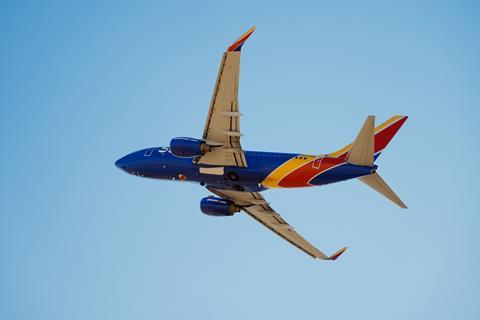
Southwest operates a massive all-737 fleet, including newer 737 Max 8s as well as 737-700s and -800s. Fleets data provided by aviation analytics firm Cirium show that Southwest flies about 800 jets.
The carrier’s other 737 variants, which have larger cabins than the 737-700, do not require the removal of a row of seat to accommodate extra legroom.
For the larger 737 Max 8s and 737-800s, Southwest is narrowing the pitch between seats in its standard segment, while making more room for the extra-legroom seats.
The Dallas-headquartered carrier has yet to confirm completion of cabin retrofits across its entire fleet.
The decision to move away from Southwest’s signature egalitarian seating style came after the company turned in a series of disappointing financial performances. Facing intense pressure to enact major changes from minority investor Elliott Investment Management and other stakeholders, Southwest embraced a wholesale strategic revision that it revealed at its investor day in September 2024.
An extensive customer survey revealed that air traveller preferences had evolved since the Covid-19 pandemic, and that bare-bones low-cost offerings were generally falling out of favour.
Southwest identified three “main preferences” among respondents to its survey.
”First, customers prefer a seating model that removes the stress and uncertainty associated with open seating,” the airline said at the time.
”Second, customers want premium seating with extra legroom, especially for longer flights. And then finally, customers expect and frankly deserve a product that offers industry-leading flexibility and is differentiated from the stripped down offering of the ULCCs or other airlines’ basic economy fares.”
On 27 January, Southwest will roll out its first-ever assigned seats, with a boarding process consisting of eight numbered groups. Higher-fare tickets allow passengers to board earlier in the process. Loyalty programme members also get higher priority.
Southwest has enacted other substantial customer-facing changes, most of which have been characterised by critics as part of the homogenisation of US airlines, with Southwest becoming more like its competitors.
That has included the elimination of Southwest’s “free bags” policy and the sale of “premium” coach seats.
Southwest has previously stated that it is targeting roughly one-third of seats as extra-legroom products.
The historically domestic-focused carrier is also expanding its horizons with international airline partnerships. To date, it has struck codeshare deals with Icelandair, China Airlines, EVA Air, Philippine Airlines and Condor Airlines.