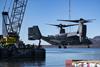











Material failure was either the cause of or contributing factor in more than half of the serious safety incidents involving the US military’s fleet of Bell-Boeing V-22 Osprey tiltrotors in recent years.
That is the conclusion of a multi-year investigation into the Pentagon’s V-22 programme launched by the US Naval Air Systems Command (NAVAIR), which is the airworthiness authority for the Pentagon’s three Osprey operators.
The review, which was released by NAVAIR on 12 December, was launched in September 2023 shortly after five US Marine Corps (USMC) personnel were killed in Australia in a V-22 crash near Darwin.
Less than six months later, a US Air Force (USAF) CV-22 crashed off the coast of Japan, killing all eight personnel onboard. The Pentagon later grounded the entire Osprey fleet for several months.
“The cumulative risk posture of the V-22 platform has been growing since initial fielding,” the NAVAIR report notes.
“Due to limitations in material solutions, funding prioritisation, and urgency, it has not promptly implemented material and non-material fixes to mitigate existing risks. As a result, risks continue to accumulate,” the document adds.

In total, 20 US military personnel have been killed in four V-22 crashes over the past four years, including the accidents in Australia and Japan, all of which saw the total loss of the incident aircraft.
A total of 12 serious Class A safety incidents involving the Osprey occurred during the 2021-2025 period reviewed by NAVAIR. A further 21 Class A events occurred between 2007 and 2020.
There have been a total of 35 fatalities associated with the V-22 since the tiltrotor reached initial operational capability in 2007.
Class A events are those resulting in fatalities or disabilities, damage exceeding $2.5 million or destruction of a military aircraft, according to Pentagon classifications.
Four of the Class A incidents since 2021 were attributed to human error, including the crash in Darwin.
During that event, the pilot lost situational awareness during landing approach and performed a series of aggressive manoeuvres that induced aerodynamic stall.
However, in seven of the V-22’s Class A mishaps “material failure was a causal or contributing factor”, NAVAIR says in the new report.
That equates to 58% of the total incidents since 2021.
A metallurgical weakness within the V-22’s proprotor gearbox (PRGB), part of its transmission, was identified as the cause of the 2023 fatal crash off the coast of Japan, now known as the Gundam-22 incident – named for the aircraft’s call sign.
A similar issue almost brought down an air force CV-22 in November 2024 over the US state of New Mexico, in what the Pentagon described at the time as a “near-crash”.
Perhaps even more worrisome, in five of the seven safety incidents for which material failure was a significant or causal factor, the problem had already been identified by the airworthiness authorities.
“These material risks were identified by the [V-22] Program Office… but were not sufficiently mitigated or resolved in a timely manner, which resulted in catastrophic outcomes in five of the 12 mishaps,” NAVAIR says.
The US military collectively operates more than 400 Ospreys, with some 350 of those assigned to the USMC in medium-lift and assault roles.
The US Navy (USN) also operates the CMV-22B Osprey variant in the critical carrier onboard delivery role, resupplying aircraft carriers at sea with critical materiel like aircraft parts.
In 2024, the navy had to abruptly pause plans to retire its last squadron of Northrop C-2A Greyhounds, when the Osprey grounding after the Gundam-22 crash took the CMV-22B fleet out of action.
The operational importance of the V-22 led the Pentagon to return the tiltrotor to frontline duty in 2024 with “material and non-material changes”, the then-commander of NAVAIR told Congress in August of that year.
Non-material changes included both new flight procedures meant to minimise wear-and-tear on components known to have degradation issues, changes to emergency landing criteria and stricter tolerances for responding to warning indicators.
However, those procedural fixes have not been sufficient, or at least not adequately adopted by frontline operators, to mitigate the underlying design issues with V-22 components.
“Despite numerous initiatives aimed at improving procedural compliance, most efforts to date have not led to significant improvements in safety outcomes,” NAVAIR says.

Each of the three US services operating the Osprey has its own safety policies and processes for implementing safety recommendations provided by NAVAIR.
“Significant discrepancies and differences” exist across the air force, navy and marines when it comes to procedures and technical publications for both aviators and maintenance personnel, according to the NAVAIR report.
“A critical gap remains in the form of specific, measurable, and enforceable action plans, complete with clear timelines and accountable owners, to address the root causes of non-compliance, improve procedural adherence, or mitigate the effects of non-compliance at the enterprise level,” NAVAIR says.
As a remedy, the airworthiness authority suggests better tracking of currency and proficiency requirements across the joint force, universal access to safety across all three fleets, more rigorous inspection of components and the establishment of specific mishap-reduction targets, plus plans to achieve those reductions.
However, the larger problem remains remedying the material deficiencies within the aircraft itself.
One major attempt to achieve that goal is already under way, having been launched by the USMC at the start of 2025.
Dubbed the Osprey Drive System Safety and Health Instrumentation (ODSSHI), the programme sees the installation of vibration sensors in each V-22 to better monitor PRGBs for deterioration. Each PRGB is also being replaced with a new version that features parts made from more durable triple-melt steel.
However, the NAVAIR report highlights the slow pace of that work, which began in June.
The USMC is retrofitting its fleet of 350 MV-22s at a rate of less than four aircraft per month – meaning it will take more than eight years to address the entire inventory.
Although it has a smaller fleet of just 50 CV-22s, the USAF will still need almost three years at its current PRGB retrofit rate of 1.5 aircraft per month. The USN is moving at a similar rate, but with a slightly smaller fleet of CMV-22Bs.
NAVAIR notes there are “differing service priorities and risk-tolerance levels” that are impacting the pace and completeness of both material and non-material safety mitigations.

A separate issue known as hard clutch engagement, which is responsible for multiple catastrophic in-flight failures in recent years, still does not have a material fix.
The problem has instead been addressed with revised flight procedures and a reduced lifespan limit for a component called the input quill assembly (IQA), which is a subcomponent of the gearbox.
A redesigned IQA is currently being tested.
“We are actively implementing remediation plans,” NAVAIR commander Vice Admiral John Dougherty says. “We are confident these actions will ensure the V-22 remains a vital asset for the joint team and for our nation’s defence.”
However, the review completed by Dougherty’s command reaches a less optimistic conclusion, especially if frontline operators fail to comply with the remedies prescribed by NAVAIR.
“Catastrophic outcomes, including both fatal and non-fatal consequences”, will likely be the result if the V-22 programme does not take “immediate and decisive action on the findings in this report”, NAVAIR says.
The airworthiness authority also highlights the impending need for a mid-service life upgrade, if the Pentagon hopes to achieve its plan of keeping the Osprey flying until the 2040-2050 timeframe.