





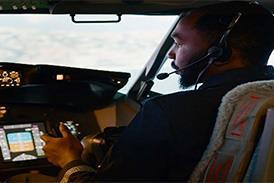








Network-centric warfare has been a mantra for military planners since the turn of the century, and industry, including EDGE, is responding with an array of technologies that give commanders more tactical awareness and ways of striking the enemy than ever
The way wars are fought changes fundamentally every generation or so. The industrialisation of weaponry meant the attritional, trench-based grind of the First World War was very different to the swift confrontations of the 1800s, while three decades later, the evolution of long-range bombers, aircraft carriers, U-boats, and tanks revolutionised conflict again. The helicopter, fighter jet, and cruise and ballistic missile were among significant breakthroughs in the second half of the century.
From the turn of the millennium, network-centric warfare – where battlespace dominance is achieved through central control of dispersed military assets using information technology – has become the decisive doctrine. Today, advances in electronic warfare (EW), autonomy, stealth, cyber technologies, satellites, and artificial intelligence (AI) offer military chiefs greater tactical awareness and more options than ever.
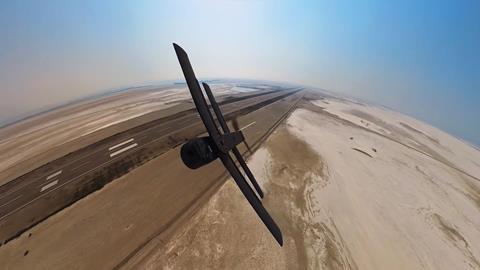
Equipment such as smaller and lighter drones and faster, more versatile smart munitions – coupled with data sourced from a network of satellites or surveillance platforms in the skies – means even junior commanders on the ground have a real-time knowledge of the battlefield and a range of solutions unavailable to their predecessors.
EMERGING TECHNOLOGIES
Just some of the developments that strides in AI, autonomy, unmanned traffic management (UTM), and ISTAR (intelligence, surveillance, target acquisition, and reconnaissance) make possible are swarming drones – uncrewed air vehicles that act in concert like a flock of birds or school of fish – and loitering munitions that can circulate unseen over a target for hours waiting for the ideal opportunity to strike.
To that list can soon be added quantum technology, which will make possible even more reliable navigational and timing systems on weapons, and more secure battlefield communications. All these are technologies that EDGE is developing considerable expertise in. “We are designing for current and future warfare,” declares Omar Al Zaabi, president of the group’s Commercial cluster.
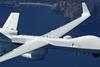
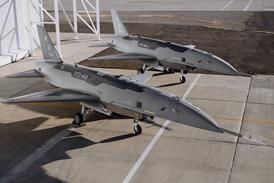
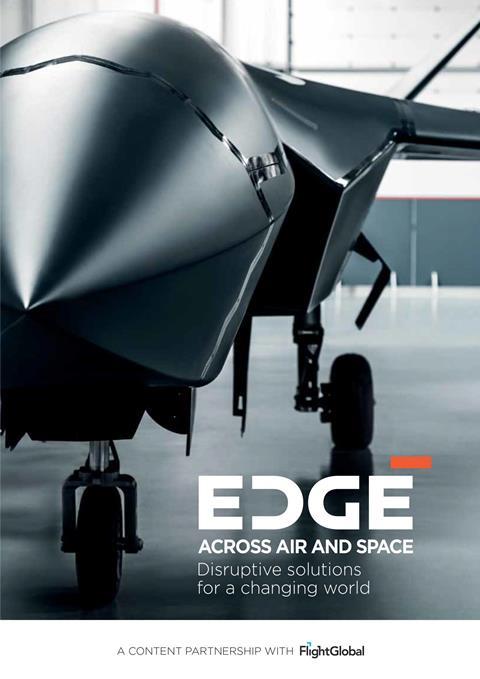
This is highlighted by EDGE’s current portfolio of platforms, missiles, weapons and other capabilities, as well as some of its key products under development. One of the most notable of the latter is Omen, a next-generation medium-sized vertical take-off and landing (VTOL) autonomous air vehicle on which it is collaborating with US defence technology firm Anduril and unveiled at this year’s Dubai Airshow.
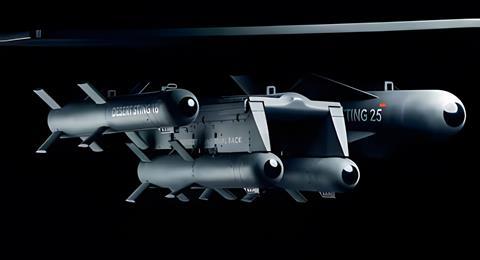
Omen will offer the speed, endurance and autonomous performance of larger, fixed-wing platforms in a VTOL format that means it can operate independently of runways, a crucial advantage in a conflict zone where the nearest airfield might be many kilometres distant. The aircraft will also provide secure beyond-line-of-sight connectivity, another vital factor in battlefield awareness, whether over land or sea.
Meanwhile, the AL TARIQ range of precision guided missiles from the EDGE entity of the same name gives battle planners the ability to launch accurate, all-weather, long-distance stand-off engagements against stationary or moving targets, in a GPS-denied environment. The system uses imaging infrared and laser dual-mode seekers and has lock-on before launch (LOBL) and after launch (LOAL) capability. Maximum range is 120km, but EDGE is working on extending it to 200km.
AI “is everywhere” when it comes to the evolution of electronic warfare
Lighter weaponry from EDGE’s HALCON stable that is in service includes the 290km-range, 1,100kg take-off weight SABER, an air launched cruise missile, developed for the UAE air force, and able to fly at 20,000ft. The turbofan-powered platform can carry a payload of 350kg and cruise at Mach 0.8, using satellite communications to navigate.
Meanwhile, two of the loitering platforms from EDGE’s ADASI entity that play a role in the networked battlefield include the SHADOW 50, a 9h-endurance uncrewed aerial vehicle that can deliver precision strikes up to 250km away. With advanced guidance features and onboard video navigation, the 2.14m-long SHADOW 50 can deliver payloads of up to 50kg.
TACTICAL PRECISION
At the lighter, tactical end of the market, the fixed-wing, 13kg HUNTER 2-S loitering munition has an endurance of 45min and range of 50km. The weapon, capable of carrying a 2kg payload, is tube-launched and hovers over the target zone, with a remote pilot designating the target and deciding when to engage.
EW and sensors also feature high in EDGE’s development objectives in the tactical warfare arena, with two recently established centres of excellence – for radar and EW, and also for electro optics – under the leadership of Dr Chaouki Kasmi, president of Technologies and Industrialisation. As with almost every other new product area from EDGE, AI “is everywhere” when it comes to the evolution of EW, radars, and sensors, says Kasmi.
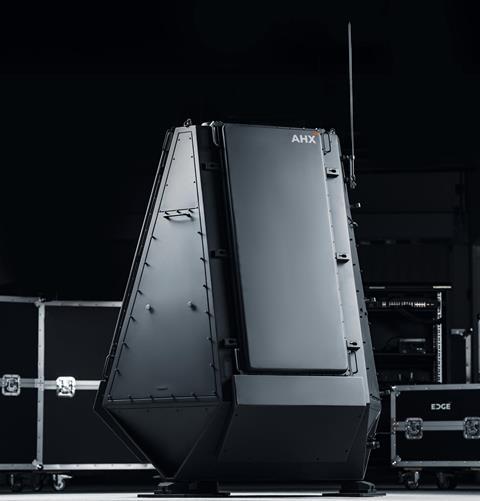
At the Dubai Airshow, EDGE is unveiling its latest radar. The AL HARRIS-X (AHX), is a multi-function, next generation active electronically scanned array (AESA) – or as EDGE describes it a “digital element scanning array” – radar that is moving from prototyping to test phase. The product uses AI to process data tracks and give command and control operators the critical information they need about an incoming asset’s trajectory or profile, while speeding up decision making.
According to Kasmi, AI – along with other breakthroughs such as autonomy, datalinks, and the miniaturisation of platforms and payloads – is driving a revolution in tactical warfare, enabling commanders to have even more awareness of the enemy’s movements and intentions, precise targeting, and a reduced risk of collateral damage. These are trends that EDGE – as one of the world’s most technologically-led defence companies – is addressing daily with its ever-evolving offering of products and solutions.
Beyond platforms and payloads, EDGE is advancing the digital backbone of the battlefield, integrating cyber and electronic threat intelligence within a unified C5ISR framework. Under an AED 4 billion contract, the group is also equipping the UAE armed forces with a suite of secure communications systems, including KATIM sovereign encryption boxes, anti-jam software-defined radios, and sovereign data links.
“The strength of any force now rests on the integrity of its networks and the information it relays,” says Waleid Al Mesmari, president of Space and Cyber Technologies. “Our goal is to guarantee secure, continuous connectivity and a unified operational picture across every domain.
Maintaining an EDGE
The UAE defence house’s innovative, disruptive and affordable technologies are helping equip customers with the assets they need to protect their national security, as more industry players around the world line up to be part of the six-year-old group’s success, says its CEO
- 1
- 2
 Currently
reading
Currently
reading
Connecting the battlefield
- 4
- 5
- 6