


















Exploiting opportunities beyond the Earth’s atmosphere – both in the defence and commercial arena – is a priority for EDGE, which is playing a key role in an evolving UAE space ecosystem
The UAE has travelled far in space since launching its first satellite – Thuraya-1, a telecoms platform built by Boeing – 25 years ago. Since then, its progress has been extraordinary, with the nation sending astronauts to the International Space Station in 2019 and 2023 and its Hope probe to Mars in 2020.
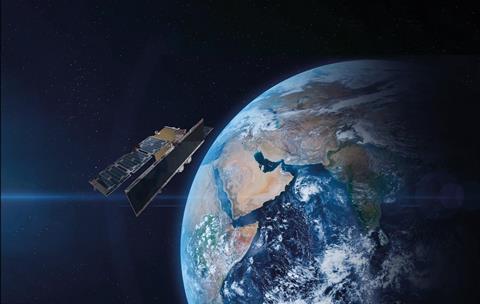
The latest project is 813 – the Arab world’s first home-grown Earth observation satellite and named after the year said to mark the start of the Islamic Golden Era of intellectual advancement – developed by teams from 11 Middle Eastern countries, led by the UAE.
EDGE is “well positioned to be a champion in the evolving national space ecosystem”, working with a series of local partners and with the UAE Space Agency as the “guiding force”, explains Waleid Al Mesmari, president of EDGE’s Space & Cyber technologies cluster.
“We are an advanced technology development house and a manufacturing powerhouse,” says Al Mesmari. “Our role is to help create sovereign capabilities to forward the interests of the UAE, whether that is in the military sphere, or in climate conservation, disaster relief or building smart cities.”
Just over a year ago, EDGE launched its new space company, FADA, a name derived from the Arabic word for the cosmos, with a mission chiefly to develop Earth observation payloads as well as other satellite technologies.
One of its flagship projects is the launch of a low-Earth orbit (LEO) constellation of advanced imaging satellites for the UAE based on synthetic aperture radar (SAR) technology, named Sirb after the Arabic term for a flock of birds. Sirb is a UAE Space Agency-led initiative.
Other programmes include AIN, a LEO optical satellite that provides high-resolution images for use in areas such as maritime surveillance, search and rescue, and climate change monitoring.
Emirati entities that FADA is working with on these and other developments include Space42, the UAE-based AI-powered spacetech company with global reach, and the Technology Innovation Institute (TII).
“Space is always a collaboration,” insists Al Mesmari, with the various organisations, from research bodies to small businesses in the supply chain “all complementing each other”.
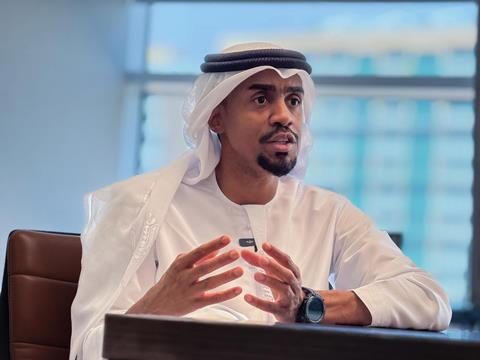
EDGE’s chief contribution to the UAE’s space effort is to be a design authority and production resource, he adds, harnessing the group’s experience in military technologies such as SAR and sensors, together with the manufacturing base of subsidiary companies such as HALCON and EPI.
And while EDGE’s DNA is in the defence world, its approach to the space sector is to design technologies as dual use. “From the beginning, our strategy has been around how space can lend itself to the two domains. Our mindset is to serve both the commercial and military markets,” says Al Mesmari.
“Our Earth observation capabilities and expertise in data analytics enable us to provide different applications such as disaster relief, water resourcing, urban planning, and vegetation management,” he says.
“The security side is important to us too, building secure systems that can protect the UAE’s interest. But by dual use licensing we can extend our market access and market share, helping to protect the prosperity of the UAE while extending a helping hand to our brothers and sisters throughout the world.”
As in many other spheres, AI is playing a prominent role in the development of EDGE’s space technologies, allowing the customer to make sense of vast swathes of information, explains Al Mesmari.
INTELLIGENT SYSTEMS
“When you are ingesting data from different sources, you need a way to process, cleanse, and analyse it to enable the right decision-making process,” he says. “AI will help us go through this trove of data to identify, for example, which are friendly vessels, and which are potentially dark vessels.”
Al Mesmari “has a dream” of constellations of satellites that “manage themselves and talk to peers”, including working in harmony with lower-altitude drones. “So, with perhaps some minimal command-and-control input on Earth, these satellites are taking decisions,” he says.
AI is playing a prominent role in the development of EDGE’s space technologies
He offers the example of SAR-based satellites teaming with uncrewed air systems equipped with electro-optic (EO) sensors to assess the progress of a volcanic eruption. “There might be an instance when the EO won’t work, so the satellite itself decides to switch to SEO, all without a human in the loop,” he says.
While EDGE has a “responsibility to address national security and sovereignty” issues with its space endeavours, it also has a goal of being an export champion, maintains Al Mesmari.
“EDGE is a developer of advanced technology with affordable prices to cater for East, West, North, and South,” he says. “The neutrality of the UAE allows us to access many different markets.”
One solution it is bringing to market is a “federated image portal” that will allow business or government customers such as farmers or urban planners to quickly access images from a range of providers. “It’s a new concept, a one-stop shop,” says Al Mesmari. “We are disrupting the status quo, and that’s what we do at EDGE.”
As with EDGE’s other business units, FADA is also playing a key role in engaging and nurturing the next generation of talent. With the UAE Space Agency and Space42, it recently hosted a Space Roadshow at six Emirati schools and universities, highlighting the many opportunities in the UAE’s burgeoning space sector.
Maintaining an EDGE

The UAE defence house’s innovative, disruptive and affordable technologies are helping equip customers with the assets they need to protect their national security, as more industry players around the world line up to be part of the six-year-old group’s success, says its CEO
- 1
- 2
- 3
 Currently
reading
Currently
reading
The next frontier
- 5
- 6