












Questionable altitude data and challenges facing new army pilots are among factors that have surfaced as part of the National Transportation Safety Board’s investigation into the fatal 29 January mid-air collision near Washington.
During the first day of a three-day hearing on 30 July, investigators focused on barometric altimeter data generated by the US Army Sikorsky UH-60L Black Hawk that flew into a PSA Airlines regional jet, killing all 67 people on both aircraft.
The NTSB also released thousands of pages of investigation documents. One retired Army pilot told investigators that less-experienced Army pilots can struggle when transitioning from newer to the Army’s older Black Hawk models.
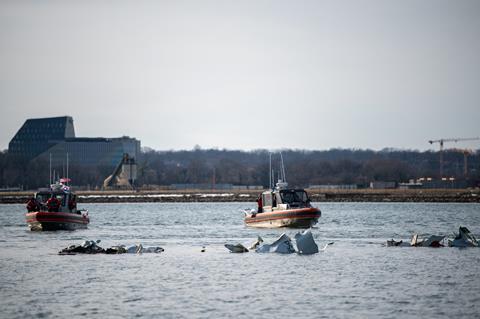
The collision sent the Black Hawk and the MHIRJ CRJ700 regional jet plummeting into the Potomac River, marking the first fatal crash of a large US airliner since 2009.
Investigators previously said the Black Hawk had been flying higher than allowed in the Route 4 flight corridor it was traversing. The regional jet was descending and was seconds from landing at Ronald Reagan Washington National airport.
The NTSB has not released conclusions about the cause of the accident, but the 30 July hearing and newly-released documents fill some holes.
Assigned to the US Army’s 12th Aviation Battalion, the UH-60L took off from Davidson Army Airfield in Virginia, on a training mission. On board were an instructor pilot, a junior pilot undergoing an annual proficiency and readiness test, and a crew chief.
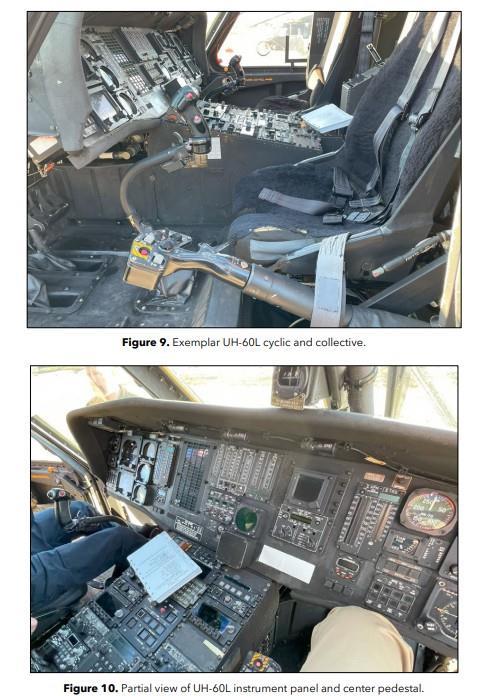
The US Army operates both UH-60Ls and newer UH-60Ms. The -60L, or Lima model, an updated version of the original UH-60A, has older technologies, including cockpits with analogue gauges, while the -60M ’Mikes’ have glass cockpits and more-automated flight control systems.
When interviewed by NTSB investigators, the retired Army pilot noted that new Army pilots train in UH-60Ms, becoming familiar with advanced systems.
“When you have someone that learned to fly… [on] a Mike model, then you take them into a Lima, you go from digital displays to steam gauges, and they have a hard time. It affects their scan,” the pilot said.
“Usually the big issue with the Lima [is] maintaining altitude…maintaining at exactly 200ft over the water is challenging,” the pilot added. “In a Mike model, I can roll in radar-alt hold… at 200ft.”
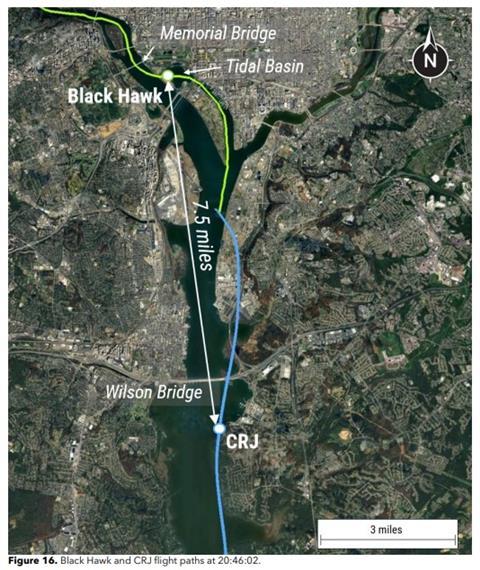
Prior to the 29 January collision, the UH-60L was flying south in an altitude-restricted helicopter flight corridor called Route 4, which runs along the east side of the Potomac River, close to Reagan National airport, which is on the river’s west side.
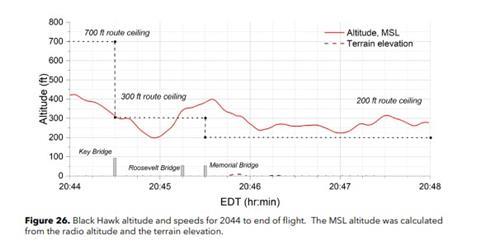
Flying along the river and approaching the airport, the UH-60L pilots correctly descended below a 300ft cap when passing over the Key Bridge. Roughly 1.3 miles further south they were supposed to descend to 200ft.
FLYING TOO HIGH
Instead, they climbed to 400ft before flying at altitudes ranging from 250-300ft as they neared the airport. Several minutes later, at 20:48 local time and at 278ft altitude, the UH-60L slammed into the CRJ700, which was descending to land on Reagan’s runway 33.
Like other aircraft, UH-60Ls carry two types of altimeters: radio altimeters, which use radio waves to determine height above ground or water, and barometric altimeters, which use pressure to derive altitude.
Unlike radio altitude, barometric altitude is height above mean sea level. It is based on a related scale called “pressure altitude”, but adjusted for accuracy by pilots, who enter local pressure settings.
In UH-60Ls, radio and barometric altimeters are adjacent in the cockpit and both are analogue, though the radio device also presents a digital reading. The devices often give different readings as a result of what they are measuring.
But the figures should have been close when the Black Hawk was flying over the Potomac River because the river is at mean sea level, NTSB documents note.
The UH-60L’s flight data recorder captured radio altimeter data and another data set wrongly labelled as barometric altitude data, says the NTSB. In actuality, that data set was pressure altitude.
BAROMETRIC ALTITUDE
When the collision occurred above the Potomac, the Black Hawk’s flight data recorder logged a pressure altitude that was 80ft less than its radio altitude. That pressure altitude would equate to a barometric altitude (the figure displayed in the cockpit) of 100ft lower, assuming the barometric altimeter was set and functioning properly, an NTSB report says.
Those figures are “not consistent with the atmospheric conditions at the time,” it adds.
To better understand the UH-60L’s altitude readings, the NTSB conducted test flights in May using three UH-60Ls.
“For all three helicopters in the altimeter test, the barometric altimeter was 80-130ft lower than the radio altimeter when over the river,” the report says.
Questionable altitude data alone does not explain the accident.
Pilots know to watch for discrepancies between radio and barometric altimeters. During the 30 July hearing, a US Army witness also told investigators that pilots tend primarily to reference radio altimeters.