














US investigators have disclosed that an Air Canada Rouge Airbus A319 pilot undergoing captaincy training queried whether a go-around should be executed just before the jet landed short of Nashville’s runway 20L.
While the daylight approach – conducted under satellite-assisted area navigation – had been stable, the aircraft encountered heavy rain at about 200ft.
The candidate captain, who was flying manually, requested activation of the windshield wipers and stated that he “lost the runway” shortly afterwards, says the US National Transportation Safety Board in preliminary findings.
Although he asked the line-training captain whether a go-around should be initiated, the line-training captain could see the runway environment, despite rain distortion, and “believed the aircraft was on the glidepath”, it adds.
The safety board says the crew continued the approach but, as the thrust levers were retarded to idle, the candidate captain was “startled to see the runway threshold lights directly ahead of the aircraft’s nose”.
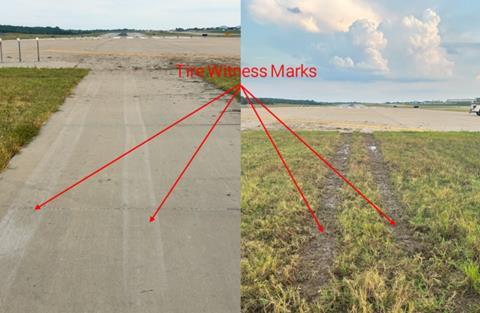
Analysis of tyre marks shows the aircraft’s landing-gear touched down about 420-430ft before the threshold. The right-hand wheels contacted grass, some 50ft before the paved runway surface, while the left-hand wheels were on a service road.
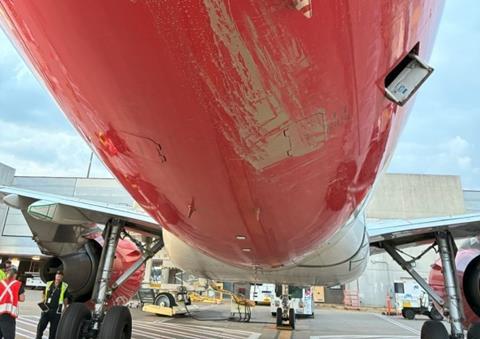
As the aircraft rolled onto the runway it struck a threshold light. Inspection of the jet revealed mino damage to a tyre and mud on the empennage.
“The crew perceived that the airplane touched down on the blast pad, a paved surface preceding the runway threshold,” says the safety board.
None of the 93 occupants was injured during the 14 August incident, the cause of which is still under investigation.