













US investigators are recommending that the FAA evaluate reducing the altitude at which future collision-avoidance systems are inhibited, in order to offer protection closer to the ground.
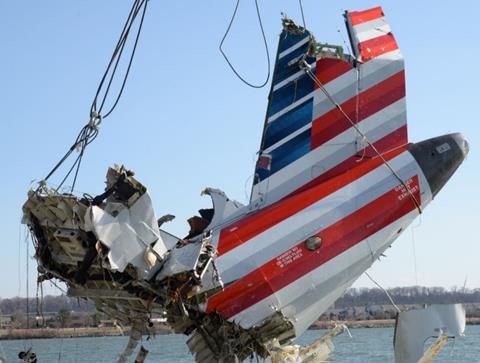
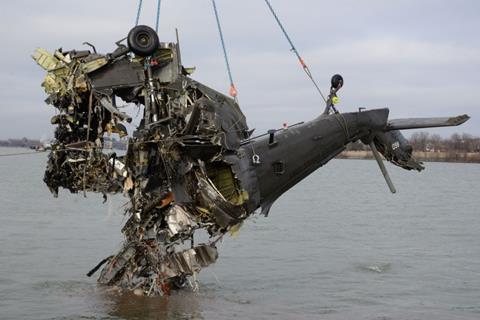
The recommendation has emerged from the inquiry into last year’s mid-air collision between an MHIRJ CRJ700 regional jet and a Sikorsky UH-60L military helicopter over the Potomac river in Washington DC.
It occurred about 300ft above the river.
Limitations of the collision-avoidance systems on both aircraft “precluded effective alerting” of the impending accident, the National Transportation Safety Board has formally determined during a 27 January meeting on its investigation.
The jet crew received a traffic advisory from its TCAS collision-avoidance system about 20s prior to the accident.
Although the jet’s TCAS operated as designed, the inquiry says, it was “ineffective” because the system is inhibited from generating resolution advisories – instructions for the pilot to take evasive action – below certain altitudes.
This inhibition is imposed below 900ft when the aircraft is descending, and below 1,100ft when the aircraft is climbing.
The restriction is intended to reduce the risk associated with executing evasive manoeuvres close to the ground.
Collision-avoidance technology is evolving with a new system, ACAS X, which uses a different concept to predict the likelihood of a conflict, reducing nuisance alerts.
ACAS X is also modular, with versions specifically adapted to different operational requirements – among them ACAS Xa for commercial aircraft, and ACAS Xr intended for helicopters.
Minimum operational performance standards for ACAS Xr are still being developed but could be completed in the third quarter of this year.
“Although not yet commercially available, had the helicopter been equipped with [ACAS Xr] with integrated aural alerting, the crew could have received an alert regarding [the CRJ700] and could have taken action to avert the collision,” the inquiry has found.
According to the NTSB’s airplane systems group chair, Caleb Wagner, ACAS Xr could reduce the risk of near mid-air collision by more than 50% even without changing inhibit altitudes for TCAS.
But the inquiry is recommending that the “feasibility” of decreasing ACAS Xa inhibition altitudes for both traffic advisories and resolution advisories, in order to provide improved alerting “throughout more of the flight envelope”.
If this evaluation finds that the inhibition altitudes can be safely decreased, it adds, aircraft should be retrofitted with systems incorporating such a modification.