















US investigators have revealed moments of confusion as air traffic controllers at two facilities tried to deconflict a SkyWest Embraer 175 and a US Air Force Boeing B-52H bomber near Minot airport, North Dakota, last year.
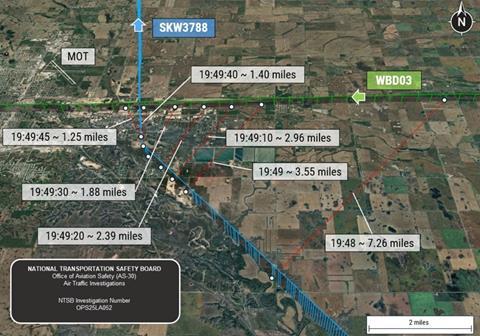
The B-52 had been travelling east to west at 2,700ft to make a fly-by over fairgrounds situated just to the south of the airport.
At the same time the E175 was conducting an area navigation approach from the southeast to Minot’s runway 31.
One air traffic controller was present in Minot tower, co-ordinating the inbound E175 and B-52 with Dakota radar approach control through a dedicated voice communication line.
The E175 crew contacted the tower to report being 1nm from the final approach fix – a way point designated FONAD – at about the same time as the tower controller made visual contact with the bomber.
Owing to the presence of the B-52, the tower controller asked the E175 crew to make a 360° right-hand orbit at FONAD.
But the crew were uncertain, citing visible traffic, and were instead offered a left-hand orbit – at which point the crew asked to break off the approach.
The tower controller, over the voice line to radar approach, requested the break-off and was told to issue a 250° heading and 4,200ft altitude. But the controller instructed the E175 to fly a 250° heading and maintain 3,700ft.
After calling radar approach to verify the instructions – and receiving a reply for a 220° heading and 4,200ft altitude – the tower controller inadvertently gave these directions to the B-52 crew, before telling them to disregard.
The controller then asked the E175 crew if they had copied, to which the crew replied with different figures, before being instructed to fly the 220° heading at 4,200ft.
When the E175 crew requested instead to fly their present heading at 4,200ft, the tower controller passed this to the radar approach controller, who thought initially that this instruction was for the B-52.
The National Transportation Safety Board states that, during the occurrence, the E175 and B-52 closed to a separation distance of 1.25nm about 2nm south of Minot airport.
It adds that, as the B-52 continued heading west, another loss of separation – with a horizontal distance of 0.33nm – occurred with a Piper PA-28 which had been performing local pattern operations at Minot.
The inquiry has yet to reach conclusions over the 18 July incident.
None of the occupants of the three aircraft was injured. The E175, which proceeded north after breaking off the approach, was vectored back to Minot where it landed on runway 31.