














Start-up US aircraft developer Electra this year doubled its workforce and expanded its facilities as it progresses toward finalising the design of its hybrid-electric prototype EL9 regional aircraft, with a goal of achieving first flight in 2027.
The private company, which is developed a “blown-lift” passenger and cargo aircraft capable of “ultra-short” take-offs and landings, expects to complete one more round of funding ahead of achieving EL9’s service entry, with chief executive Marc Allen considering various options to raising money.
“We see private paths and we see other paths,” Allen told FlightGlobal on 2 October, without being more specific. “We think there are unique advantages to being private during this development stage.”
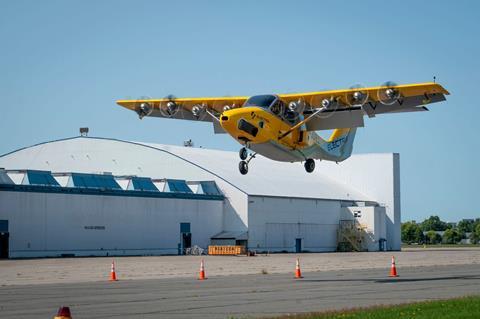
Electra has already completed hundreds of flights with its smaller EL2 blown-lift demonstrator.
“Agility. Flexibility. Taking smart, prudent risks – all of these line up well with private capital,” he adds, saying Electra has accomplished much with fewer people than employed by competing firms in the so-called advanced air mobility (AAM) sector. “We punch way above our weight.”
Allen’s comments come the same week another AAM start-up – Beta Technologies – said it is pursuing an initial public offering of stock on the New York Stock Exchange.
Electra has doubled its staff this year, reaching a headcount of roughly 90 full-time employees, with roughly half of this year’s new-hires being engineers. Others include supply chain staff and the company’s first services and support workers. The company also secured $115 million in fresh funding this year.
Electra intends within the next year to hire “dozens more” engineers, says Allen. “We are staffing out all the different parts of the integrated product team that are doing the hard engineering work to build the EL9.”
The company has meanwhile expanded its facilities, opening a new 1,394sq m (15,000sq ft) hangar and adding office space at Manassas Regional airport in Virginia. Electra is based in Manassas, which is about 30 miles (48km) west of Washington, DC.
Additionally, Electra has added space to its research and development site in the Swiss city of Bleienbach, a location that gives Electra access to European engineering talent, says Allen. Bleienbach is also where Electra completed initial testing of the hybrid-electric system powering its EL2 blown-lift demonstrator.
Electra has now flown that aircraft several hundred times since its maiden flight in 2023.
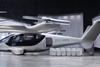
Like EL2, Electra’s in-development EL9 production aircraft is to have eight wing-mounted propellers driven by a distributed electric architecture supplied by a hybrid system composed of a battery pack and turbogenerator.
Safran will supply the EL9 prototype’s turbogenerator, though Electra is considering bids from other companies to supply turbogenerators powering its ultimate production-conforming EL9.
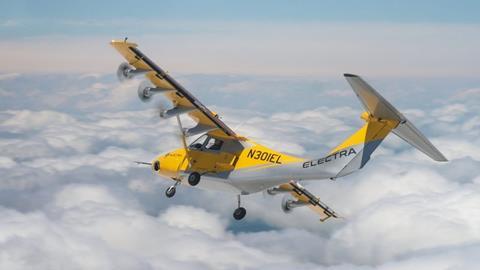
Not having bulky wing-mounted engines makes possible the “blown-lift” design, which involves the propellers blowing air around and against the wings and flaps in a manner that generates additional lift, allowing for much shorter take-offs and landings than possible with convention aircraft, Allen says. “You can’t hang turbines on the wing and make it work.”
The EL9 is to carry nine passengers or 1,361km (3,000lb) of cargo, cruise at 175kt (324km/h) and have 1,100nm (2,037km) of range. Most notably, Electra insists the blown-lift design means the aircraft needs only 150ft of distance to take off or land.
“We have been advancing the state of the design,” Allen says of the EL9, adding that the company is holding preliminary design reviews and will head toward its critical design review next year. It plans to have a full-scale EL9 mock-up in its hangar within a few months.
Electra has received some early EL9 components from suppliers but is working still to finalise the aircraft’s “bill of materials”.
“We are putting together contracts with core suppliers,” says Allen. “The entire programme is now standing up on its feet.”
Electra aims to fly the EL9 prototype for the first time in 2027, to begin certification-credit flights in 2028 or 2029 and to achieve Federal Aviation Administration certification in 2029 or 2030.
Electra spent recent months completing EL2 demonstration flights.
“We used the summer to take the prototype and put her through her paces, both with some commercial customers and critical military stakeholders,” says Allen.
Electra flew the EL2 in the Air Force Research Laboratory’s Future Flag technology demonstration event, held in August and September in New York state. There, Electra demonstrated the EL2’s capabilities, helping the US Air Force “understand its usefulness to the war fighter” and its ability to be integrated with air force units, says Allen.
Electra has landed other US military contracts and views its aircraft as uniquely suited for military missions.
Also, in partnership with Surf Air Mobility, a US aviation company that holds rights to acquire EL9s, Electra demonstrated EL2 at Virginia Tech, landing the aircraft on a road, parking lot, field and a 300ft paved “drone pad”.
Story corrected on 6 October to note that Electra landed $115 million, not $119 million, in funding earlier this year.