








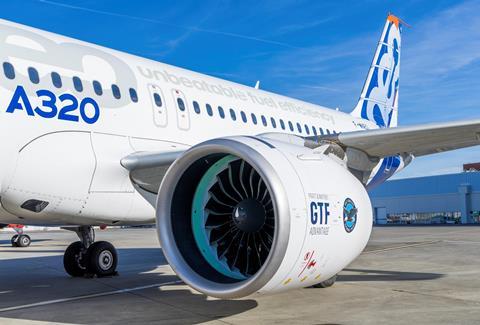
The Federal Aviation Administration has responded to several Pratt & Whitney PW1100G engine fires by requiring airlines remove fuel hose clamps and replace mounts within hundreds of turbofans.
The agency mandated the work in an airworthiness directive (AD) published on 12 January, giving airlines 30 days from the order’s 17 February effective date to complete initial maintenance tasks.
PW1100Gs are one of two power options on Airbus A320neo-family jets, the other being CFM International Leap-1As.
“This AD was prompted by multiple reports of fan-blade fracture events, three of which resulted in an engine under-cowl fire,” says the regulator. “The FAA is issuing this AD to prevent a fuel leak resulting from a fan blade fracture.”
The action applies to 586 PW1100Gs on US registered jets. It comes as airlines muddle through a separate PW1000G recall stemming from a metallic-component manufacturing problem that can cause engine failures. That recall has forced airlines globally to ground hundreds of jets.
The FAA’s 12 January AD notes that P&W already recommended airlines complete maintenance steps to address the fire-risk issue. The manufacturer issued those recommendations in service bulletins released in recent years.
Asked to comment, the engine maker says, ”The AD is consistent with the actions published in Pratt & Whitney service bulletins previously released to operators and has been nearly completed across the fleet.”
The FAA’s new AD mandates those actions, and soon.
Within 30 days of 17 February, carriers must remove a “loop cushion clamp” associated with a fuel tube assembly. Then, during the next engine shop visit, they must replace “thermal management system clevis mounts” with redesigned mounts and replace the loop cushion clamp.
P&W’s service bulletins provide more details about the problem. Fan-blade failures, such as those caused by bird strikes, can cause the thermal management system mounts to fracture in a way that cracks a fuel tube. Removing one of the clamps can as an interim measure “increase flexibility of the tube and prevent cracks”, it says.
The FAA estimates that completing the maintenance work on each engine will require 125 work-hours.