













Engine shortages aside, Airbus’s chief executive is confident the company will meet its 2025 delivery goals, while conceding that hitting the target depends on engine makers CFM International and Pratt & Whitney getting production back on track.
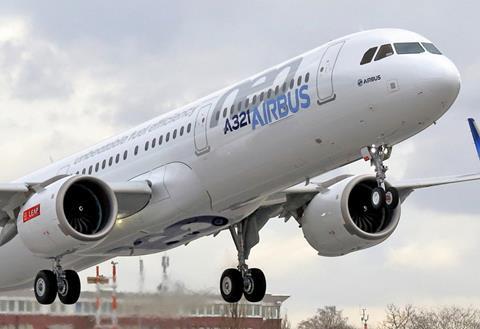
Delayed deliveries of CFM Leap-1A and PW1100G turbofans left Airbus at mid-year holding roughly 60 A320neo-family “gliders” – jets produced except for missing engines.
“We are a bit behind on deliveries, because we have produced aircraft without engines,” Airbus chief executive Guillaume Faury said on 9 September. “We continue to be on track for about 820 aircraft deliveries [in 2025], conditioned on engines.”
Airbus set that goal in February. But in 2025 through August, the company delivered 434 jets – an average of 54 monthly. It would need to deliver another 386 aircraft during the last four months of the year – or 96 monthly – to hit the 820 mark.
Faury says supply chain troubles that have hamstrung Airbus since the Covid-19 pandemic are broadly improving, with “most” suppliers now delivering components to Airbus’s schedule.
“There are a few exceptions, and the one that is impacting us the most…is indeed the difficulties of the two engine makers – CFM and Pratt – to deliver to us on time,” he said, speaking at the US Chamber of Commerce Global Aerospace Summit in Washington, DC.
Engine shortages have been emblematic of the aerospace industry’s supply chain problems – and also among the trickiest to overcome.
Grappling with a dearth of skilled labour and with their own supply chain problems, CFM and P&W are still struggling to hike output following contraction during the pandemic.
CFM’s Leap-1A is one engine option for A320neo-family jets, while P&W’s PW1100G geared turbofan is the other. CFM’s Leap-1B is the sole engine option for Boeing’s 737 Max; limited supply of that engine variant has also constrained Boeing’s output.
Airbus’s production has been more affected by shortages of Leaps than of PW1100Gs.
“It’s mainly CFM,” Faury says. “It has slightly improved, but there is still a lot we need to get from the engine makers between now…and the end of November.”
Still, he expresses confidence CFM and P&W will get on track as the year wraps up, enabling Airbus to hit its 2025 delivery goal.
“What we hear from our engine colleagues is that they will be back [by] the end of the year,” he says. “They are real-specific issues to deal with. We see that they are managing those issues, that they are mostly behind them…I am reasonably comfortable.”
Faury adds that engine availability commonly tightens around mid-year before improving in the second half of the year – a reflection of airlines’ clamouring for new spare engines ahead of the busy summer travel season.
Airbus has a history of getting more aircraft into customers’ hands during the final months of the year. For instance, it delivered 123 aircraft in December last year.