


















GE Aerospace has started tests to help ensure the open-rotor engine it is developing under its CFM International partnership retains adequate durability when operated in dusty and sandy conditions.
The company, which owns CFM with Safran Aircraft Engines, recently started two series of dust-ingestion tests, subjecting high-pressure turbine airfoils to conditions that can cause early engine degradation.
The airfoils are part of GE’s “compact core” – a smaller, hotter-burning and higher-pressure engine it is developing as part of CFM’s Revolutionary Innovation in Sustainable Engines (RISE) programme.
RISE is CFM’s effort to bring to market an open-rotor turbine for the next generation of narrowbody passenger jets.
GE says that, for the compact core, it has started dust-ingestion tests sooner in the programme’s timeline than for any of its prior engines.
“We are doing these tests earlier and earlier… We’re doing it during the demonstration phase of technology maturation, and that is the new normal,” says GE future of flight vice-president Arjan Hegeman. “So we have more and more time to make sure we have full durability maturity.”
In the past, such as for CFM Leaps, which power Airbus A320neo-family jets and Boeing’s 737 Max, GE conducted dust-ingestion tests after service entry.
Durability has proven a problem with several new-generation engines, including Leaps, which have needed maintenance sooner than expected, particularly if operated in sandy and dusty conditions. That is because, experts say, the engines burn hotter and at higher pressure than earlier designs.
GE’s compact core will be hotter and higher-pressure still. It consists of a high-pressure turbine and high-pressure compressor.
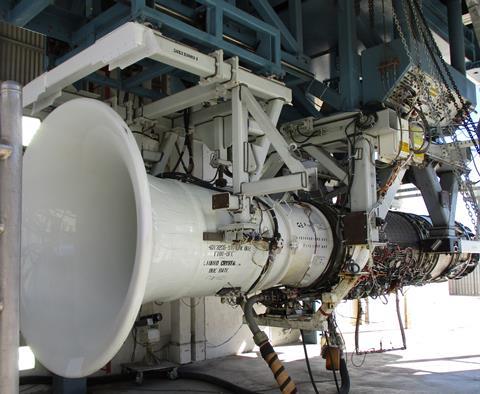
The company is using two existing engines as test beds for the dust-ingestion tests: a Leap-1A, which powers Airbus narrowbodies, and an F110, the F-15 fighter jet’s powerplant. The new airfoils have been installed in those test engines.
“A specialised test rig injects dust into the engine over thousands of cycles, representing take-off and climb, cruise and landing,” CFM says. The dust used is “a proprietary mix of sand and other particles developed by GE Aerospace” over 15 years.
The company uses various dust formulations to “emulate the different harsh… environments that our operators are getting”, and to “replicate the failure modes that we are seeing in our fleet”, Hegeman says.
GE plans to complete 3,000 simulated flight cycles of testing.

Ensuring the blades do not overheat is key to durability. Toward that end, GE has developed “cooling technologies that enable the blades to run in a hot gas path without the blade getting damaged”, Hegeman says, without being specific.
He adds that CFM’s open fan will have a unique characteristic that will keep some dust and dirt out of the centre of the engine.
While two streams of air move through traditional turbofans (bypass air and air moving through the engine), the open fan will have three. Those include bypass air and two streams passing through the engine, one of which will exit the engine before entering the hottest and highest-pressure section, says Hegeman. A “centrifugal filter mechanism” will cause dust and dirt to be expelled via that stream.
“We truly have nailed down what those flows are all looking like [and] how the overall operation cycle of the engine is,” Hegeman says. “The effectiveness of the dust filtering is phenomenal… That is all inherent to that open-fan architecture. You cannot replicate that in a ducted engine.”
GE aims to demonstrate its compact core later this decade. It has been developing the technology partly under NASA’s Hybrid Thermally Efficient Core programme.
CFM estimates the RISE open rotor will be 20% more efficient than today’s engines thanks to several technologies, including the compact core.